


Both promise to take the guesswork out of distance. The right one for you depends less on which is “better” and more on how you actually play.
Ask five golfers whether a rangefinder or a GPS watch is better and you’ll get five confident, contradictory answers. The truth is neither one is better — they solve the same problem in different ways, and most people end up owning whichever their playing partner had, rather than the one that actually suits how they play.

What a rangefinder actually does
A laser rangefinder gives you one precise number for whatever you point it at. Aim it at the flag, press the button, and you get an exact distance to that specific target — not an estimate, not a zone, an exact yardage to the pin itself. The trade-off is that it needs a clear line of sight, and it takes a few seconds of aiming each time.
What a GPS watch actually does
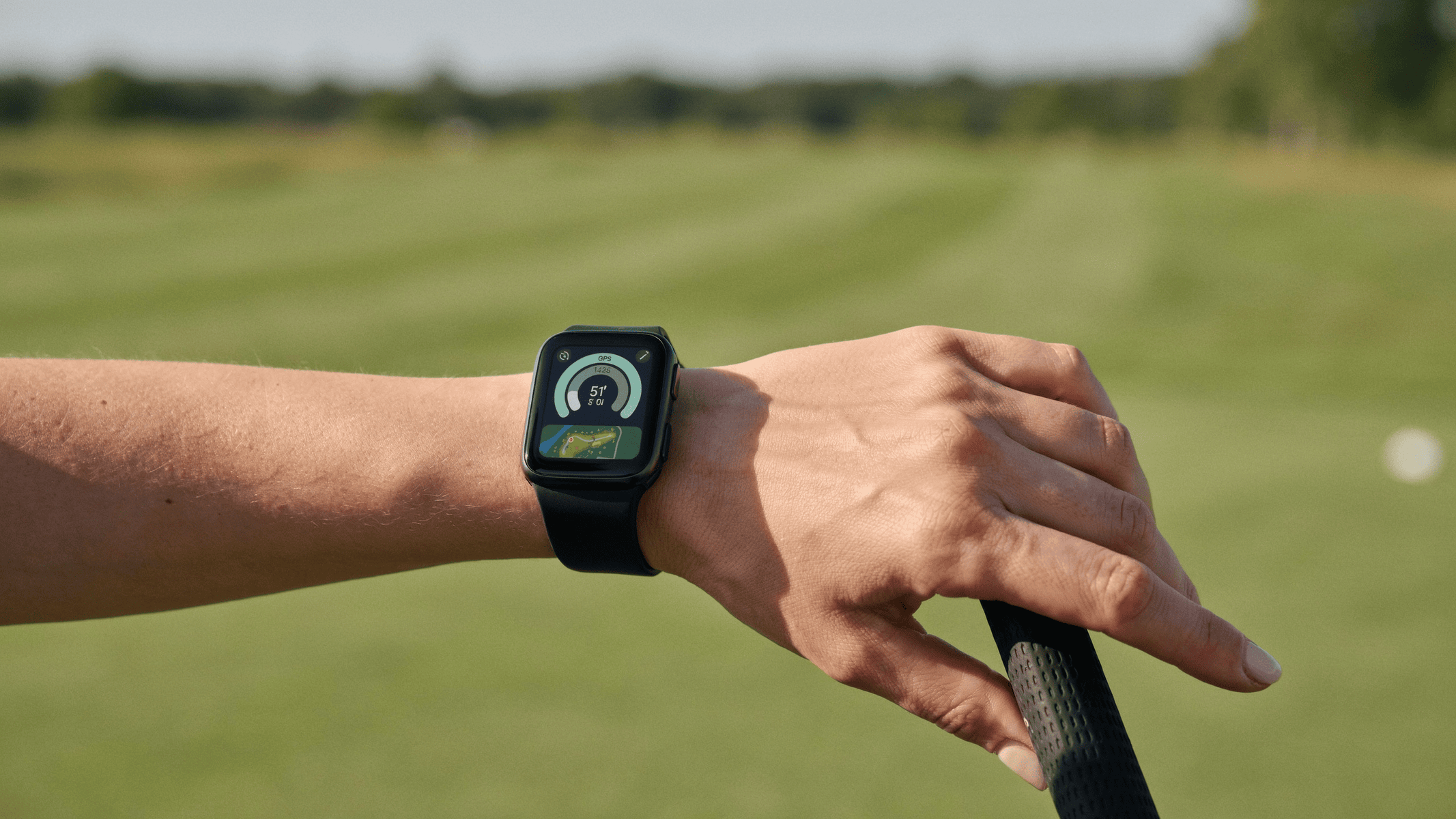
A GPS watch works from preloaded course maps rather than what you’re looking at. It gives you distances to the front, middle and back of the green automatically, with no aiming required — glance at your wrist and the numbers are already there. Most also double as a regular smartwatch, tracking steps, heart rate or your round history alongside the golf features.
What each one actually costs
Laser rangefinders typically run £150–£350, largely depending on whether you want extras like slope adjustment or higher magnification — and that’s a one-off cost with nothing further to pay. GPS watches cover a similar £150–£400+ range, and while most now include free course updates, some ecosystems still charge for premium mapping or live shot-tracking add-ons. Worth checking what’s included before you buy, not after.
The decision factors that actually matter
Accuracy vs. convenience. A rangefinder gives you a precise number to a specific point — useful if you want the exact distance to a tucked pin, not just the green. A GPS gives you a faster, hands-free number that’s accurate enough for most approach decisions.
Speed of play. If you play in a group that moves quickly and you don’t want to be the one holding things up while you aim, a GPS watch is the lower-friction option. A rangefinder suits players happy to take the extra few seconds for precision.
Competition legality. Most club competitions run under the Model Local Rule permitting distance-measuring devices, but slope- or gradient-adjusted readings aren’t allowed in strict Rules of Golf play. Whichever you choose, it’s worth knowing whether your device’s slope function needs to be switched off for competition rounds — that’s on you to manage, not the device.
Battery and course coverage. A GPS watch depends on preloaded maps and battery life lasting the full round, and some models need periodic course updates. A rangefinder doesn’t need course data at all — it just measures whatever you point it at.
A simple way to decide
If most of your golf is competitive medal or matchplay where you want the exact number to a specific flag, a rangefinder probably suits you better. If you mostly play unfamiliar courses, want distance at a glance without stopping to aim, or already want a fitness watch anyway, a GPS watch is the more convenient fit. If you play socially in a group that moves at pace, the hands-free option will make you a more relaxed playing partner.
There’s no objectively correct answer here — only the one that matches how you actually play.

Read more – Choosing a Golf Ball That Actually Works for Your Game


