


Before you buy another hybrid, fairway wood or wedge, check what your current clubs actually deliver. A simple distance check could reveal a gap worth filling—or an overlap that needs a closer look.
You’re standing over an approach shot, deciding between two clubs. One has a longer shaft and a lower number, so it ought to go further. Yet on the course, there rarely seems much between them.
That is a useful equipment question to investigate before adding anything else to your bag.
“Gapping” means looking at the distance differences between your clubs. The aim is a set that gives you useful options for the shots you face, rather than a collection of clubs that look evenly spaced on paper.
Start with the clubs you’re unsure about
You don’t need to test your entire bag at once. Begin with two or three clubs that leave you hesitating: perhaps your longest iron, a hybrid and a fairway wood, or your pitching wedge and the next wedge down.
At a launch-monitor session, ask to compare their carry distances—the distance the ball travels through the air. Keep total distance, which includes roll, in a separate column.
Warm up first, then hit a small group of shots with each club. Look at the pattern rather than selecting your longest shot as the distance that club “goes”.
If you mishit most attempts, that matters too. Ask a coach or fitter to help distinguish an equipment overlap from a contact problem before making a buying decision.
Look for gaps—and overlaps
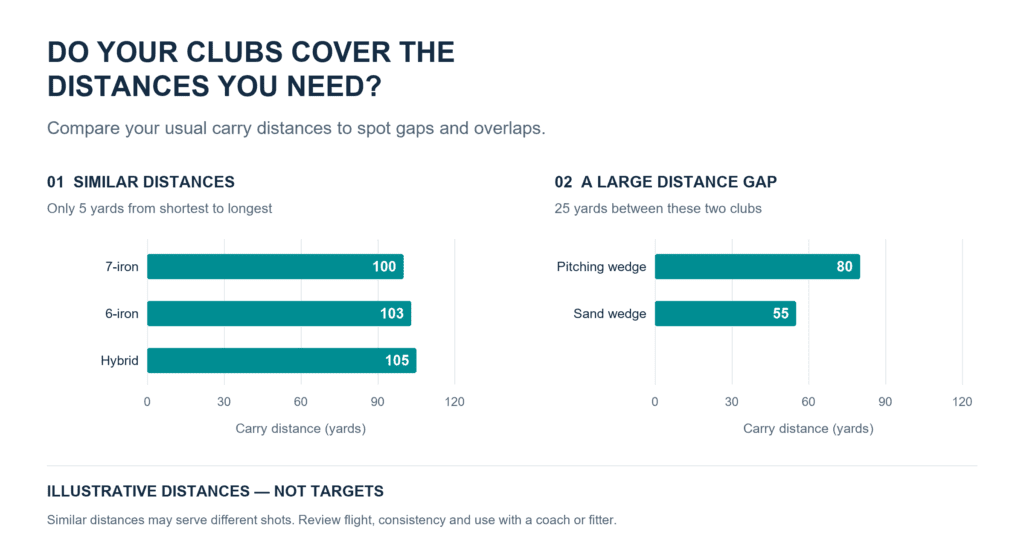
An unusually large distance jump may explain why you repeatedly find yourself between clubs.
At the other extreme, two clubs might produce very similar distances. Don’t immediately remove one: distance is only part of its job.
Does one launch higher? Is another easier to use from the rough? Do you trust one from a tee but struggle with it from the fairway?
Those differences may justify keeping both. The question is whether each gives you a useful option when you play.
Take your existing clubs to a fitting
If you’re considering a new club, bring the ones it would sit between. Ask to compare them during the session.
A club that produces an impressive individual shot still needs to fit into your set. Titleist’s fitting guidance identifies distance gapping as part of that process: checking the spacing between clubs rather than assessing each in isolation.
Your question for the fitter is simple: “What job would this club do that my current clubs don’t?”
Leave with information, not necessarily a purchase
Ask for a record of your usual distances and any areas worth reviewing. Note whether the readings are carry or total, so you don’t mix them up later.
You may discover a genuine space for another club. You may find that a club you already own deserves more use—or that a lesson would be a better next step.
Either way, you’ll be making the decision around your game, rather than buying a new club and hoping it finds a role.
READ MORE: What to Expect from a Custom Club Fitting


