

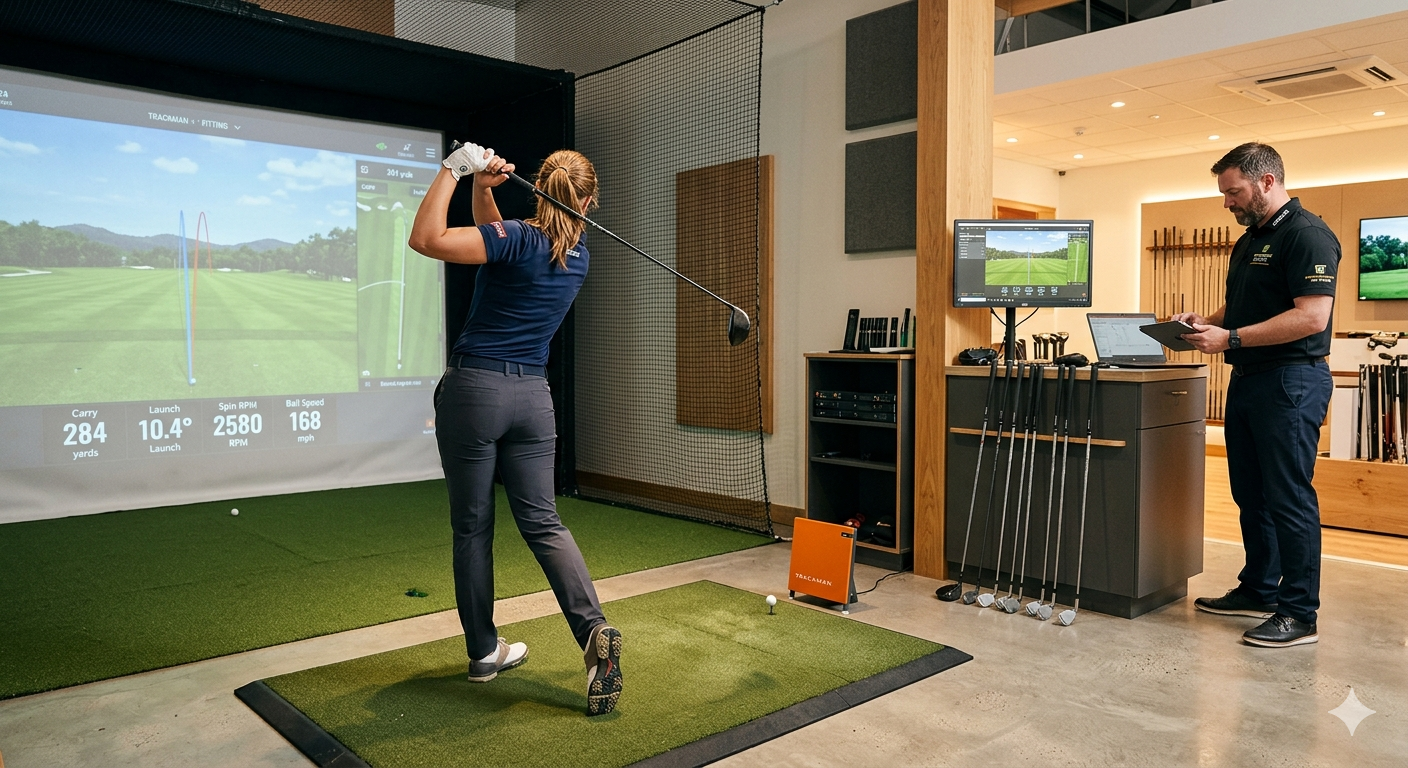
Custom fitting sounds serious. It doesn’t have to feel that way. Jane Carter, Women & Golf Editor, walks you through exactly what happens — and why leaving with a spec sheet, not a purchase, is often the right outcome.
Most women golfers have heard that they should get fitted for their clubs. Fewer have actually done it. The reasons are familiar: it feels like something for serious players, it sounds expensive, and the whole thing seems a bit intimidating if you’re not sure what to expect. This guide is here to change that.
What follows is a straightforward account of what a custom fitting involves — what happens in the room, what the data means, what you’ll take away, and crucially, what nobody is expecting you to buy. Think of it as a friend who’s been through it telling you what she wishes she’d known beforehand.
It’s Not a Lesson — and You’re Not Being Judged
The first thing to understand about a fitting is that it’s not an assessment of your ability. The fitter isn’t watching your backswing to see where you’re going wrong. They’re watching what happens to the ball — the flight, the launch, the spin — and using that data to work out which combination of shaft and head suits how you actually swing right now.
There’s a launch monitor in the room. It will generate numbers. Those numbers are not a scorecard for your technique. They’re measurements that help the fitter do their job — matching the equipment to you, not to some theoretical standard player. You do not need to swing perfectly. You just need to swing normally
It’s for You — Wherever You Are in Your Game
“I’m not good enough to be fitted yet.” It’s one of the most common reasons women put fitting off, and it’s the wrong way round. A golfer with a lower handicap can compensate, at least to some extent, for clubs that don’t quite fit her. A higher-handicap golfer generally can’t — which means ill-fitting equipment is making an already challenging game harder than it needs to be.
Here’s what fitting means at each stage of your game.
The Established Golfer (handicap 20–36) — You play regularly and you want golf to feel easier. Fitting is likely to show up things you’ve been working around without knowing it: clubs that are slightly too long, a shaft that’s too stiff for your swing speed, grips that are too thick. Small adjustments here can make a noticeable difference to your contact and your consistency.
The Improver (handicap 10–24) — Your game is developing and you’re starting to understand what you need from your equipment. A fitting at this stage helps you stop fighting your clubs and start getting more from the swing you’re building. It’s also worth knowing: clubs that fit you now may not fit you in two years if your game keeps moving. A re-fit is normal.
The Advanced Golfer (single figures and below) — You already know your game well. Fitting for you is about precision: dialling in shaft weight, flex point, and lie angle to match a swing that’s repeatable and specific. You’re also the most likely of the three to find that the right club for you isn’t in the women’s section at all.
Brand Fitting or Independent Fitting — Know the Difference
This is the bit most fitting guides skip, and it matters. There are broadly two types of fitting available, and they’re not the same thing.
A brand fitting — whether at a manufacturer’s fitting centre, a retailer demo day, or an in-store fitting session — works within that brand’s range. The fitter will know that product well. If you already have a strong preference for a particular manufacturer and want to dial in the right spec from their range, this is a sensible option. The limitation is obvious: you’ll only ever be shown one brand’s clubs, regardless of what might actually suit your swing best.
An independent fitter works across multiple brands. They have no stake in which manufacturer you end up with. Their job is to find the combination of head and shaft that produces the best numbers for your swing, from whatever brand that turns out to be. If you have no strong brand preference, or you simply want the most objective result, an independent fitting is worth seeking out.
Neither option is wrong. But go in knowing which one you’re booking.
What Happens in the Session

A fitting for a single club — a driver, say, or a set of irons — typically takes around an hour. A full-bag fitting can run to two and a half hours, which is a long time to be hitting balls. Many fitters, and most golfers, find it works better to spread a full-bag fitting across more than one session. Worth asking when you book.
Wear your golf clothes and golf shoes. Bring your current clubs — the fitter will want to see you hit with them first, to establish a baseline. That comparison between what your current clubs are doing and what a better-fitted option does is one of the most useful parts of the whole session.
The session will usually start with a short conversation: your game, what you’re finding difficult, what you’re hoping for. Then some basic measurements — your height, your wrist-to-floor measurement, your hand size. These inform the starting point for shaft length and grip size. Then you’ll hit balls, the launch monitor will collect data, the fitter will start testing alternatives, and the picture will build from there.
It’s a conversation throughout, not a silent examination. Ask questions. Tell the fitter what you’re feeling, not just what the numbers say.
The Numbers on the Screen — What They Mean
The launch monitor generates a lot of data. You don’t need to understand all of it. These are the ones most likely to come up in conversation.
- Club head speed: How fast the head is moving at impact. This is one of the key factors in determining which shaft flex and weight will suit you.
- Ball speed: How fast the ball leaves the face. Higher ball speed generally means more distance. The relationship between club head speed and ball speed is called smash factor — a higher smash factor means you’re transferring energy efficiently.
- Launch angle: The angle at which the ball leaves the clubface. Too low and the ball won’t carry; too high and you lose distance. The fitting is partly about finding the launch angle that maximises carry for your swing speed.
- Spin rate: How much backspin is on the ball. High spin can cause the ball to balloon and lose distance. Low spin can cause it to drop out of the sky early. Getting spin in the right range is part of what fitting achieves.
- Carry distance: How far the ball travels in the air before it lands. This is the number most golfers care about, and it’s the one most likely to improve with better-fitted equipment.
- Dispersion: How tightly grouped your shots are. A fitting should tighten your dispersion — not just add distance, but make your misses less bad.
Your Specs Sheet — and No Obligation to Buy

A good fitting ends with a written record of what was found: the shaft flex, shaft weight, club length, lie angle, and grip size that produced the best results for your swing. That document belongs to you. Think of it like a glasses prescription — it’s information about you, generated by a professional, for you to use as you see fit.
You can use it to order clubs on the day. You can take it away and order later, from a different retailer if you choose. You can file it and come back to it in a year. No reputable fitter will pressure you into purchasing on the day, and if you feel pressured, that’s worth noting.
There is sometimes a fitting fee — typically in the range of £50–£100 for a single-club session, more for a full bag. Many fitters will credit this against a purchase if you go ahead. It is money well spent either way: you are paying for information, not for clubs.
Questions Worth Asking
Getting the most from a fitting is partly about being willing to speak up. These are worth raising.
- Are you brand-agnostic? Worth confirming at the start if you’re not sure what type of fitting you’ve booked.
- What shaft weight are you recommending, and why? Flex and weight are different variables. A lighter shaft can be as important as the right flex for many women golfers.
- What grip size are we working with? Grip sizing is one of the most overlooked elements of a fitting. Standard grips are often too thick for smaller hands and can affect the way the club releases through impact.
- What will be on the spec sheet? Make sure the document you leave with covers all the key specifications, not just the brand and model.
- When should I come back? Ask when a re-fit would make sense — when your handicap changes significantly, if you’ve had an injury, or simply after a few years of regular play.

Worth Watching
Women-specific fitting video content is, frankly, thin on the ground. Most manufacturer videos show male golfers, tour-level swings, or both. That said, two resources are worth your time and Women & Golf will be producing a lot more.
Women’s Golf Club Fitting…Amazing Results! (YouTube, September 2023) — A genuine women’s fitting session filmed in full. Accessible, real, and a good illustration of how the conversation with a fitter actually sounds. Search the title on YouTube.
Golf Club Fitting Explained — Beginner’s Guide (YouTube, December 2025) — Gender-neutral but clear and jargon-free. A useful primer on the fitting process and the technology involved if you want to understand the basics before you book.
The Jargon Buster
- Shaft flex: How much the shaft bends during the swing. Labelled as Ladies (L), Senior (A), Regular (R), Stiff (S), or Extra Stiff (X). Many women do not automatically need a Ladies flex — the right choice depends on swing speed and tempo.
- Shaft weight: The physical weight of the shaft, measured in grams. Lighter shafts can help increase swing speed; heavier shafts can improve control. A separate variable from flex.
- Lie angle: The angle between the shaft and the ground at address. If the lie angle is wrong, the face won’t be square at impact even when your swing is. Toe-up or heel-up patterns at impact often point to a lie angle issue.
- Loft: The angle of the clubface, which determines trajectory and, to a significant extent, distance. Women with moderate swing speeds often benefit from more loft than standard club specs assume.
- MOI (Moment of Inertia): A measure of how resistant a club head is to twisting on off-centre hits. Higher MOI means more forgiveness — the ball still goes roughly where you intended even on less-than-perfect contact.
- Launch monitor: The technology used to measure ball flight and club data during a fitting. Common systems include Trackman, Foresight GC Quad, and FlightScope. The brand matters less than how the fitter uses it.
- Smash factor: Ball speed divided by club head speed. A higher smash factor means more efficient energy transfer — a useful indicator of whether a club is working with your swing or against it.
Before You Book
The single most useful thing you can do before your fitting is hit a bucket of balls at the range. Not to warm up for the session — you’ll do that at the fitting — but to remind yourself what your normal swing feels like. Fittings are most accurate when you’re hitting the way you usually do, not trying to perform.
If you’re mid-lesson series and your swing is actively changing, it’s worth finishing that process before committing to new fitted clubs. Equipment fit to your swing now may be slightly off in six months if your technique is shifting. Your coach can advise on timing.
Finally: fitting is not a one-time event. Your game will evolve, and the equipment that suits you now may not suit you in three or four years. The spec sheet you leave with today is a starting point, not a permanent prescription.
About This Guide
This is a Women & Golf foundation guide. Our reviews — linked from this guide — are produced independently.
Women & Golf readers can protect their clubs, trolleys and accessories with Ripe Golf Care. Link to RipeGolfCare


