


Ever wondered why a perfectly struck shot falls short of the green when the temperature drops? It’s not necessarily your swing. Cold weather really can affect how far a golf ball travels, and understanding why could help you make better decisions on the course this winter.
You’ve hit what feels like a lovely seven iron. The contact is good, the ball takes off on exactly the flight you wanted and, for a moment, you’re already thinking about the birdie putt. Then it lands five yards short of the green.
It’s one of winter golf’s familiar frustrations. You chose your usual club, made what felt like your normal swing and watched the ball fall disappointingly short. Perhaps you put it down to a poor strike or decide that your game has somehow deteriorated since the summer.
But there’s a good chance your swing isn’t entirely to blame. A golf ball doesn’t behave quite the same way on a cold November morning as it does during a warm afternoon in July, and the difference can be enough to change the outcome of a perfectly respectable shot.
Why the temperature makes a difference
The first thing to understand is that cold weather affects the ball before it even reaches the ground. Colder air is generally denser than warmer air, creating more resistance as the ball travels towards its target. Even if you make exactly the same swing and produce the same ball speed, the ball may not carry quite as far.
According to Titleist’s research, a drop of around 11°C in air temperature can reduce distance by approximately 1.5%, although the effect varies with the conditions and the golfer. That might sound insignificant, but a few yards can make all the difference when you’re trying to carry a bunker or reach a raised green.
The ball’s own temperature can influence performance too. A ball that has spent hours in a freezing car boot may not respond quite like one kept indoors at a moderate temperature. Modern golf balls are sophisticated pieces of equipment, with their cores, covers and construction designed to deliver particular launch and spin characteristics. Temperature can influence how those materials behave at impact.
Then there’s the person swinging the club. Anyone who has played golf in several layers of winter clothing will know that it’s not always easy to make the same free, relaxed turn as you would on a warm summer day. Cold hands, stiff muscles and a bulky jacket can all make a difference, particularly if you haven’t had an opportunity to warm up properly.
Individually, these effects may be relatively modest. Together, they help explain why a club that comfortably reaches the green in August can suddenly look rather inadequate in November.
And that’s before we consider what happens when the ball lands.
When the fairways stop helping
One of the biggest differences between summer and winter golf has nothing to do with the flight of the ball. It’s what happens afterwards.
During the summer, a well-struck drive might land on a firm fairway, bounce forward and roll another 20 yards or more. On a soft winter course, that same shot can land with a thud and stop almost immediately. In particularly wet conditions, you may even find it plugged in its own pitch mark.
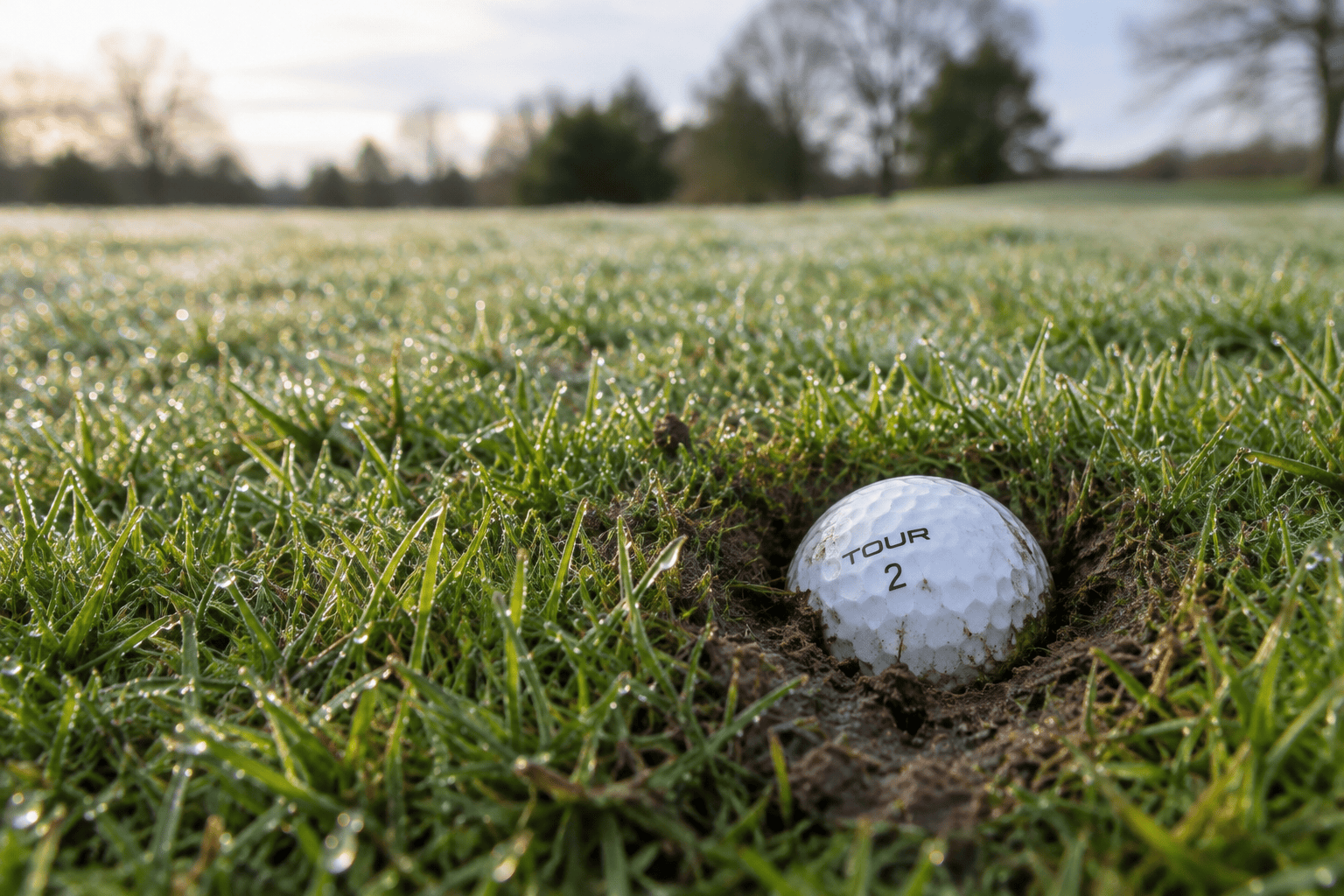
The loss of total distance can feel dramatic, even if the ball hasn’t actually travelled much less far through the air.
This is where understanding the difference between carry distance and total distance becomes particularly useful. Many golfers have a reasonable idea of how far they hit their clubs, but those numbers often include whatever roll the ball happens to receive. If your seven iron normally finishes around 130 yards away, how much of that distance is carry and how much is run?
In summer, the distinction might not seem especially important. In winter, when soft ground removes much of that extra distance, it becomes considerably more obvious.
It matters even more when you’re playing into a green protected by bunkers or water. A ball that normally lands short and releases towards the flag may simply stop where it pitches. Choosing a club based on where you want the ball to finish, rather than where it needs to land, can quickly become an expensive mistake.
There’s also the question of how the greens are playing. Softer surfaces may hold an approach shot more readily, which can be helpful, but they offer less opportunity to run the ball towards a back pin. Once again, the conditions are asking you to think differently about the shot.
Do you need a different golf ball?
Winter inevitably brings plenty of advice about equipment, and one of the most familiar suggestions is to switch to a softer, lower-compression golf ball when the temperature drops.
It’s an appealing idea. If cold weather affects how a ball performs, surely a softer model will help compensate?
Unfortunately, golf-ball performance isn’t quite that straightforward. Compression is only one element of a ball’s design, and its construction, cover, spin characteristics and suitability for your particular swing all influence the result. A lower-compression ball isn’t automatically longer in cold weather, nor will changing models necessarily restore the distance you’ve lost.
For many women golfers, there’s a good argument for continuing to use a ball they already know and trust. Familiarity with how it feels off the putter and behaves around the greens can be more valuable than chasing a few theoretical yards with something different.
That doesn’t mean experimenting is a bad idea. If you’ve been considering another ball, there’s nothing wrong with trying it and seeing whether you prefer the performance. But there’s little reason to assume that winter automatically requires a change.
Looking after the balls you already use is a more sensible starting point. Rather than leaving them in a freezing car overnight, keep them indoors at a moderate temperature before heading to the course. Deliberately warming a ball during a round to change its playing characteristics, however, is prohibited under the Rules of Golf.
The more important adjustment is likely to be the one you make when choosing a club.
Why an extra club can make all the difference
Perhaps the most useful thing you can do in winter is stop expecting your summer yardages to apply in every situation.
If you’re standing 125 yards from the flag on a cold morning, with a soft fairway underfoot and a bunker guarding the front of the green, it may be unrealistic to expect your usual club to produce its normal result. Taking one more club and making a comfortable swing could be a much better decision than trying to squeeze extra distance from the club you would have chosen in August.
Of course, winter doesn’t automatically mean taking an extra club for every shot. A strong following wind, firm ground or a downhill approach can change the calculation completely. The point is to assess the conditions rather than relying on familiar numbers.
It can also help to pay attention to your first few holes. If several well-struck shots are finishing short, that’s useful information. Instead of assuming you’ve suddenly lost your swing, consider whether the temperature and conditions are affecting your distances.
For golfers who use a GPS device or rangefinder, the yardage to the flag is only part of the decision. You still need to consider where the ball must land, what lies between you and the green and how much run you can realistically expect.
Sometimes the sensible choice is to aim for the middle of the green with a longer club. On another hole, it might be better to play short of trouble and accept a straightforward chip.
Winter golf has a way of rewarding the golfer who thinks carefully rather than the one who insists on hitting every club as far as she remembers.

A different game, not necessarily a worse one
One of the frustrations of playing through winter is the feeling that your game has somehow gone backwards. Drives don’t travel as far, approaches finish short and the ball seems reluctant to do anything helpful once it lands.
But a shorter shot isn’t necessarily a poorer shot. The conditions have changed, and your expectations need to change with them.
In fact, winter can be a useful time to become more aware of how far your shots actually carry and to develop a better understanding of club selection. Without the generous bounce and roll of summer fairways, you begin to see more clearly what the ball is doing through the air.
You may also discover that taking an extra club and swinging comfortably produces a far better result than trying to force your normal distance.
It might simply be a cold day, a soft fairway and a golf ball behaving exactly as the conditions dictate.
And sometimes the smartest way to play better winter golf is simply to reach for the six iron.
READ MORE: Winter Golf Gloves: What Do You Really Need?


