


In part II, we take a look at Shot Scope’s analysis of 2.5 million shots from 26,000+ women’s rounds and reveal exactly where rounds fall apart from 100 yards in — and what to do about it.
Most of us spend far more of every round around the greens than we’d like. Approach shots that miss, chips that don’t quite get there, putts that lip out or slide past — the short game and putting account for a huge proportion of shots on any scorecard. But how much do you actually know about where your rounds are slipping away in this part of the game?
Shot Scope’s new report — The Women’s Game, By the Numbers — gives us the clearest picture yet. Based on 2.5 million shots from over 26,000 rounds played by women golfers across seven handicap levels, the data in this section is both sobering and, in places, genuinely reassuring.
The Short Game: Harder Than It Looks at Every Level
If you’ve ever stood over a chip from 15 yards and felt the pressure build, the data explains why — and it also tells you you’re not alone, regardless of your handicap.
Shot Scope’s up-and-down figures show just how often players at every level fail to convert from around the green. From inside 10 yards, even a scratch golfer gets up and down only 61% of the time. From 20 to 30 yards, that drops to 39%. For a 20-handicapper, the numbers are 44% and 20% respectively.
Those aren’t failure statistics — they’re a reality check. The short game is where most rounds are decided, and small improvements here have an outsized effect on the final score.

The most impactful adjustment many golfers can make is club selection. From inside 10 yards, a lower-lofted club played as a bump and run takes the air out of the shot — literally. Less flight means less that can go wrong. The ball behaves more predictably, runs out closer to the hole, and removes the risk of catching the turf or skulling through the back. When the situation allows it, make the shot simpler.
Putting: The Great Equaliser — But the Gap Is Bigger Than You Think
Putting doesn’t require power, speed training, or a complete technical overhaul. It’s the one part of the game where effort, repetition, and focus can deliver the fastest gains. Which makes the data all the more worth paying attention to.
From 0 to 3 feet, the differences between handicap levels are modest — most players make these. But from 3 to 6 feet, the gap opens sharply.
Make percentage from 3–6 feet by handicap:
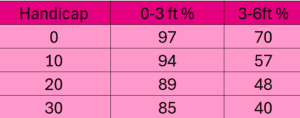
A scratch golfer holes 7 out of 10 from 3 to 6 feet. A 30-handicapper makes 4. That single range — faced multiple times every round — is where pars are saved or bogeys are made. It’s also the range where focused practice delivers the quickest results.
Three-putting is the other major drain. A scratch golfer three-putts roughly once per round. For a 30-handicapper, it’s closer to four times. Over 18 holes, that difference alone can account for three or four shots on the card.
The gap isn’t primarily about short-putt mechanics — it comes down to lag putting and distance control. Three-putts happen when the first putt rolls too far past, or stops well short, leaving an uncomfortable second putt under pressure.
What Actually Helps
For short putts inside 6 feet: pick a specific target before you step in and commit to it. Keep your tempo the same on every putt — same rhythm, same pace, regardless of the importance of the moment. Repetition on the practice green matters here: seeing the ball drop again and again builds both stroke and confidence.
For lag putting: think distance before direction. Before a long putt, try visualising the full journey — the pace, the break, where it comes to rest. Aim to leave the ball below the hole wherever possible. An uphill putt coming back is far more predictable than a downhill slider, and gives you a much better chance of making the next one.

For the short game: before you reach for your lob wedge, ask whether a straighter-faced club would do the job more reliably. The bump and run is underused by most amateur golfers — and the data suggests it’s worth practising.
KEY TAKEAWAYS
- Even scratch golfers get up and down only 61% of the time from inside 10 yards — this is a hard part of the game at every level. Small improvements compound quickly.
- Club selection around the green is the fastest short-game fix: a bump and run reduces margin for error and leaves you closer more often than a lofted chip.
- From 3–6 feet, a scratch golfer makes 70% of putts; a 30-handicapper makes 40%. This range is faced multiple times every round — focused practice here delivers fast results.
- Three-putts cost a 30-handicapper nearly four shots per round compared to one for a scratch golfer. The difference is lag putting and distance control, not short-putt mechanics.
- For long putts, think pace before line. Aim to leave the ball below the hole for a more manageable second putt.
The full eBook — The Women’s Game, By the Numbers — is free to download here. It covers tee shots and approach play too — see Part 1 of this series.


