

Just because it’s cold, wet and miserable outside doesn’t mean your new golfing journey has to stop. Indoor golf simulators offer a fun, welcoming way to keep swinging, practising and building confidence throughout the winter.
You’ve finally started playing golf. Perhaps you’ve had a few lessons, found your confidence at the driving range or even ventured onto a course for the first time. Then autumn arrives, the rain seems endless and suddenly the prospect of spending an hour outside hitting golf balls loses some of its appeal.
It’s tempting to put your clubs away until spring, particularly when you’re still learning and haven’t yet established a regular golfing routine. But taking several months off just as you’re beginning to enjoy the game can make it harder to pick up where you left off. You may find yourself having to rebuild the confidence and familiarity you’ve worked so hard to develop.
Fortunately, there’s another way to keep playing. Indoor golf simulators are becoming an increasingly accessible option, offering the chance to hit real golf shots in a comfortable indoor environment, whatever the weather is doing outside. And despite their high-tech appearance, they’re not just for experienced golfers.
What exactly is a golf simulator?
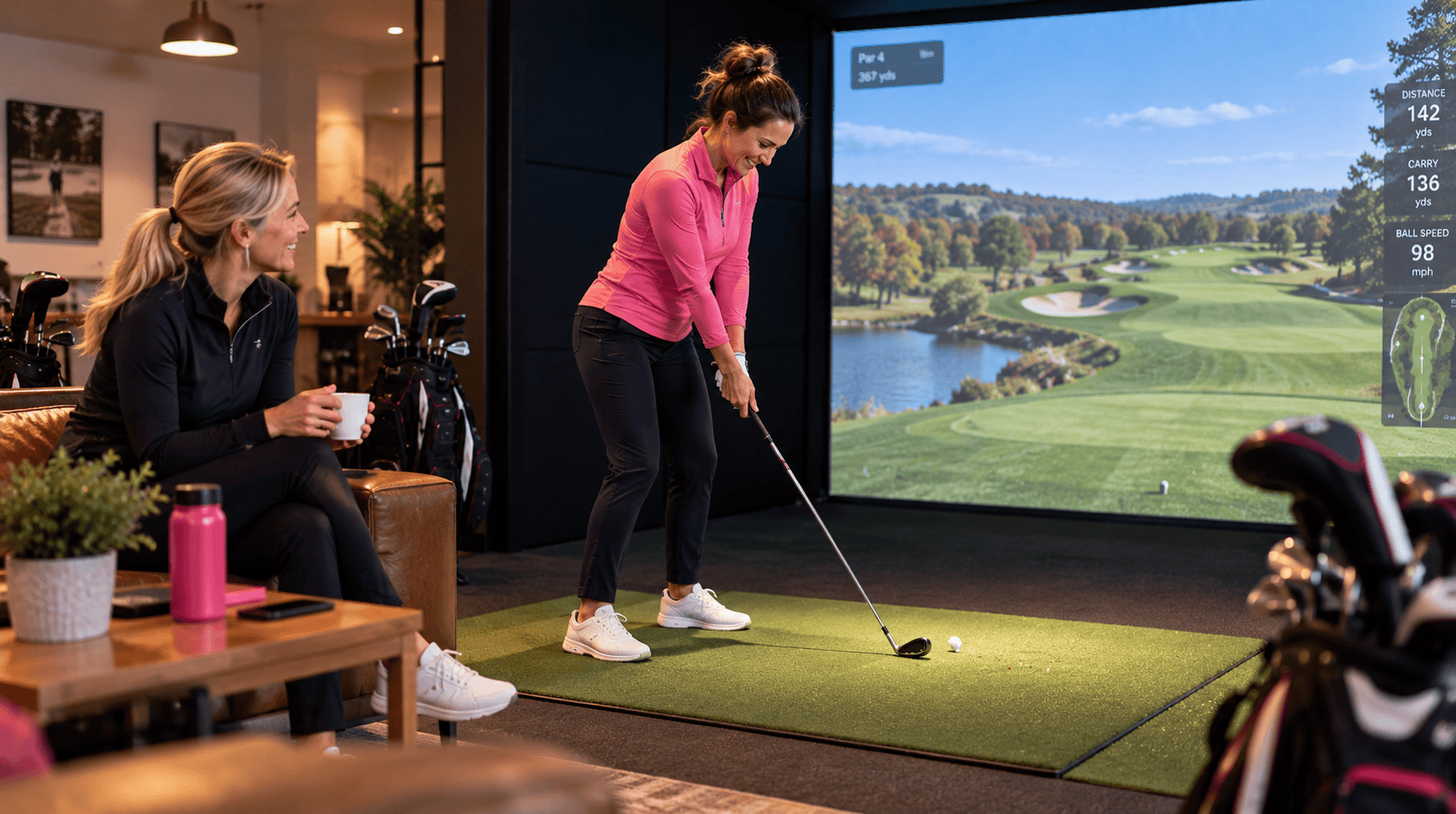
Imagine standing on a hitting mat with a golf club in your hand, facing a large screen displaying a golf course. You hit a real ball towards the screen, and technology measures your shot before showing where the ball would have travelled on the virtual course.
Depending on the venue and equipment, you might be able to play famous courses, practise on a virtual driving range or take a lesson with a golf professional. The experience varies, but the basic idea is simple: you can keep playing golf without having to brave the rain, wind or freezing temperatures.
For beginners, this can be particularly appealing. You don’t have to worry about losing a ball in the rough, holding up the group behind you or spending half your session searching for an errant shot. You can concentrate on making contact with the ball, enjoying the experience and gradually becoming more comfortable with your swing.
And there’s no need to understand all the numbers and statistics that appear on the screen. Those can become useful as your golf develops, but on your first visit, simply getting used to hitting shots in a different environment is enough.

Your first visit: what should you expect?
Walking into an indoor golf venue for the first time might feel a little intimidating, especially if you’ve seen photographs of sophisticated simulator bays filled with screens and technology. In practice, many facilities are designed to be straightforward to use, and staff can explain how everything works.
A typical simulator bay has a hitting area, a large impact screen and equipment that tracks your shots. Some venues have private bays, while others offer more open layouts. You usually book a session for a set period, although prices, facilities and the amount of assistance available vary.
You don’t necessarily need to bring a full set of clubs. Some venues provide equipment, while others expect you to bring your own, so it’s worth checking before you arrive. Comfortable clothing and suitable footwear are generally all you need, although individual venues may have their own requirements.
One particularly useful option is to book an introductory lesson rather than a completely independent session. A PGA professional or experienced instructor can explain the equipment, help you settle in and give you something simple to work on. If you’ve only recently started golf, that guidance may be more valuable than spending an hour trying to interpret what the screen is telling you.
Practice or play? You can do both
One of the attractions of simulator golf is that you don’t have to approach every visit as a formal practice session. You might spend some time hitting balls on a virtual range, play a few holes of a simulated course or enjoy a relaxed session with a friend.
For someone taking their First Swings, the ability to repeat a shot without worrying about where the ball finishes can be reassuring. You can practise using a familiar club, build confidence in making contact and enjoy seeing the ball travel across the screen. Just remember that simulator results are estimates, and hitting from a mat isn’t quite the same as playing from real grass.
There’s also a social side to indoor golf. Booking a bay with another beginner can be a lovely way to keep your enthusiasm going through the winter, particularly if neither of you feels ready to join a regular competition or play a full round outdoors.
You don’t have to be particularly good to enjoy it. In fact, that may be one of the best reasons to give it a try.
Five things to check before your first simulator session
| Is the venue beginner-friendly? | Ask whether staff can help you get started and explain how the simulator works. |
| Can you borrow clubs? | Check whether equipment is provided or whether you need to bring your own. |
| Would a lesson be better? | An introductory coached session may be the most comfortable way to begin. |
| Can you book with a friend? | Find out whether you can share a bay and how the session is charged. |
| What does the price include? | Check the session length, cost, cancellation policy and whether coaching is extra. |
Keep your golfing momentum going
Winter doesn’t have to mean putting your golfing ambitions on hold. In fact, it can be a wonderful opportunity to build confidence without the distractions of a busy course or unpredictable British weather.
A simulator won’t replace everything you learn from playing outdoors. You’ll still need to discover how to handle different lies, judge distances on a real course and become comfortable with the rhythms of a round. But it can help you maintain your enthusiasm, keep swinging and enjoy golf as a regular part of your week.
And when the longer days finally return, you won’t be starting again from scratch. You’ll have spent the winter doing something that matters far more than waiting for better weather: continuing to enjoy the game.
READ MORE: Your First Golf Lesson: What Actually Happens?


