


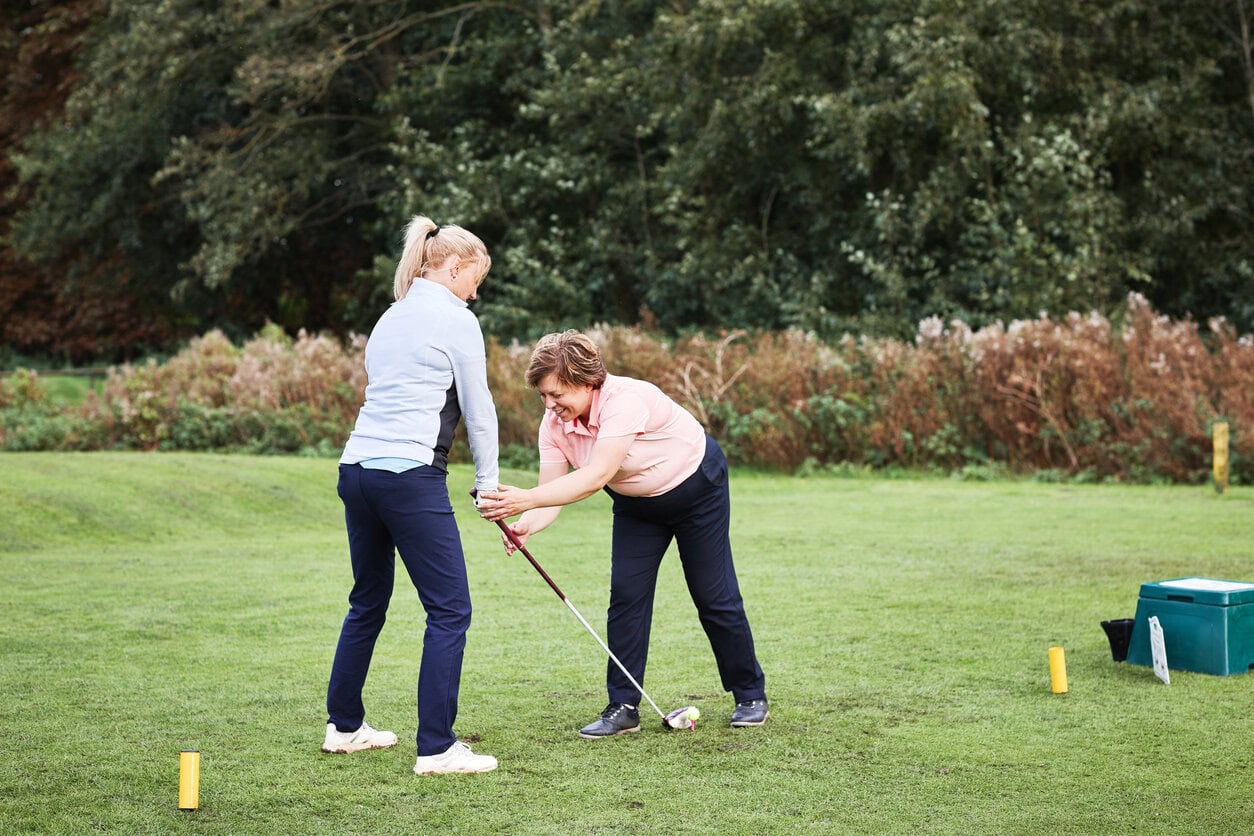
What do you need to bring, what will the coach ask and how much golf are you actually expected to know? We look at what really happens when you book your first lesson.
There’s a lovely detail in PGA Professional Emma Booth’s approach to nervous beginners. She points to the dents and ball marks on the walls of her coaching bays — evidence of all the less-than-perfect shots hit by the people who came before.
“Everyone starts somewhere,” she told PGA Play.
It is probably the most useful thing to know before your first golf lesson.
You aren’t booking a lesson because you can already play golf. You are booking one because you can’t.
The lesson starts with you, not your swing
Tell the coach you’re a complete beginner when you book. It allows you to sort out the practicalities — where to meet, what to wear and whether you need to bring clubs — but it also gives the coach an idea of where the lesson needs to start.
And that starting point may involve rather more talking than you expect.
Looking across the way different PGA Professionals describe their first sessions, there is no standard lesson plan. There is, however, a strikingly consistent theme: they want to understand the person before trying to build a golf swing.
Speaking to PGA Play about his coaching approach, PGA Professional Tom Reid puts it neatly: “I’m coaching the student and not the swing.”
Reid asks about a player’s background, how they like to learn, the time they have available and what they want from golf. His particular method includes filming pupils and providing a recorded summary afterwards; another coach may work quite differently.
More recently, PGA Professional Gareth Howell made much the same point when speaking to The PGA about his work introducing women to golf through Wales Golf’s New2Golf programme.
“The first session is all about making the person feel comfortable,” he said.
Before getting into technique, Howell wants to understand what has brought someone to golf and what they want from it. That might be playing with a partner, joining friends on the course, finding a new social activity or eventually becoming a club golfer.
For lesson one, the coach needs to know which journey you’re actually trying to start.

What should you take?
Comfortable clothing that lets you move freely and footwear with decent grip are the basics.
Clubs require a little more thought. Don’t assume you need to buy a set before your first lesson. When you make your enquiry, ask what equipment you’ll need and whether anything can be provided or borrowed.
That conversation could save you buying equipment before you have any idea what suits you.
If your lesson is at a golf club rather than a standalone range, it’s also sensible to ask about dress requirements before you arrive.
Then the golf starts
Eventually, the coach needs to see you hit a ball.
That is not an examination. It’s information.
A coach can’t discover much about the way you move by explaining golf to you indefinitely. At some point you’ll take a club and have a go.
The useful lesson from coaches who work with beginners is that this doesn’t have to mean immediately constructing a full, technically perfect golf swing.
Howell talks about setting “simple, achievable goals”. His New2Golf programme introduces participants to the short game, long game and playing on the course, but his priority at the beginning is confidence and enjoyment as well as technical development.
And things will go wrong.
You may miss the ball. You may hit the ground. A shot may travel considerably less far than you intended.
That’s where Booth’s battered coaching-bay walls suddenly make sense.
What about all the rules and etiquette?
They aren’t homework for lesson one.
In fact, one of the more useful findings from looking at beginner coaching is that learning to play golf and learning a golf swing aren’t quite the same thing.
Howell’s New2Golf programme, for example, doesn’t stop at technique. Participants learn how golf is played on the course and are encouraged to build connections with each other. More than 100 women have been through the programme, with Howell describing the social element and sense of belonging as important in helping people progress into regular golf.
Women & Golf saw something similar when we reported on The Club Company’s Women on Par sessions with England Golf in 2025. Beginners started with guidance on the range and then went onto the course for a relaxed Texas Scramble supported by female club members. The introductory sessions across the group’s 18 clubs sold out.
That distinction matters.
You can learn how to hit a ball on a range. Becoming comfortable enough to walk onto a course and play with other people is another stage of learning golf.
A good beginner pathway needs eventually to bridge the two.
One-to-one or a group?
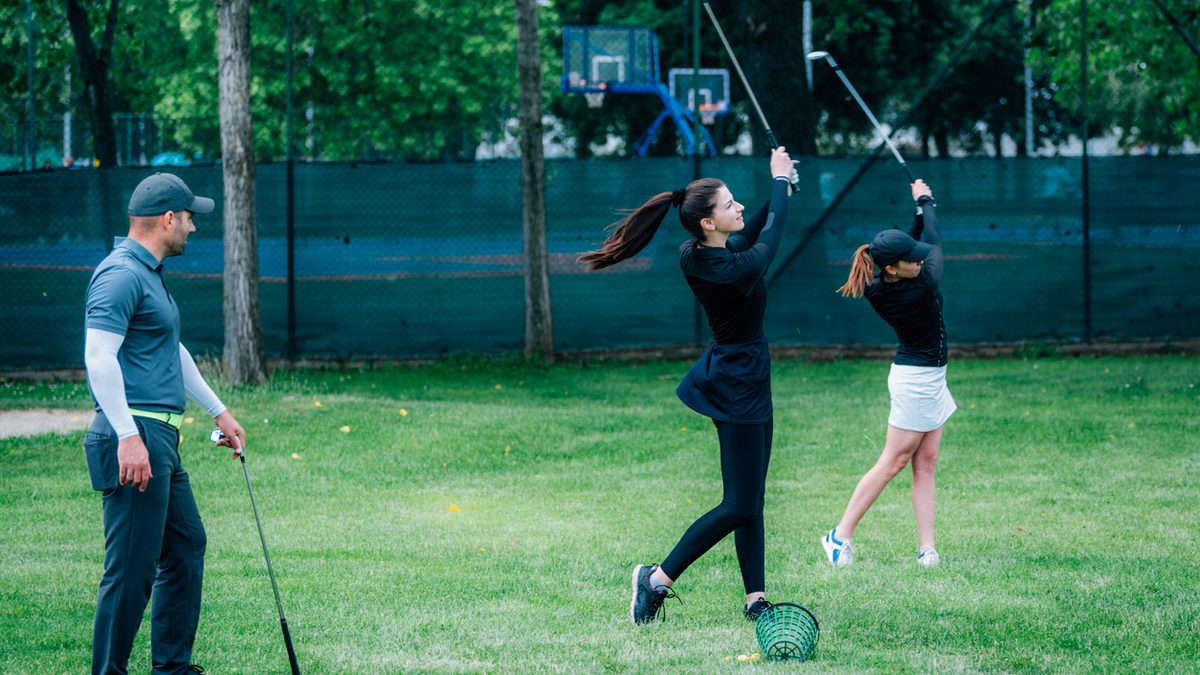
For the first lesson itself, either can work.
Individual coaching gives a PGA Professional the opportunity to work entirely around you. Group coaching gives you something an individual lesson cannot: other beginners.
Which is more valuable depends partly on why you’re learning.
If your main objective is individual technical progress, you may prefer one-to-one attention. If meeting people and eventually finding others to play with matters too, a beginner group can start building that network from day one.
You don’t have to choose one route forever. Individual lessons, group sessions, range practice and eventually playing on the course can all form part of the same progression.
What should you have achieved after lesson one?
Not a finished golf swing.
You should have a clearer idea of what you’re trying to do, something manageable to practise and an understanding of what comes next.
Before you leave, ask the coach what they want you to work on. Write down the key point or two if necessary.
Your next step might be another lesson, some practice, joining a beginner programme or eventually venturing onto the course.
And if your first few shots weren’t particularly impressive, remember Booth’s coaching bay.
Plenty of people have hit the walls before you.
Where to start
The simplest route to an individual lesson is PGA Play, The PGA’s service for finding a qualified PGA Professional. You can search by location and contact coaches directly.
In England, England Golf’s Get into Golf programme and club finder provide another route into the game.
Useful links:
- PGA Play — Find a golf lesson – https://www.pgaplay.co.uk/
- England Golf — Play Golf / Get into Golf – https://www.englandgolf.org/play-golf
READ MORE: Why a Custom Club Fitting Might Be the Best £100 You Spend This Autumn


