

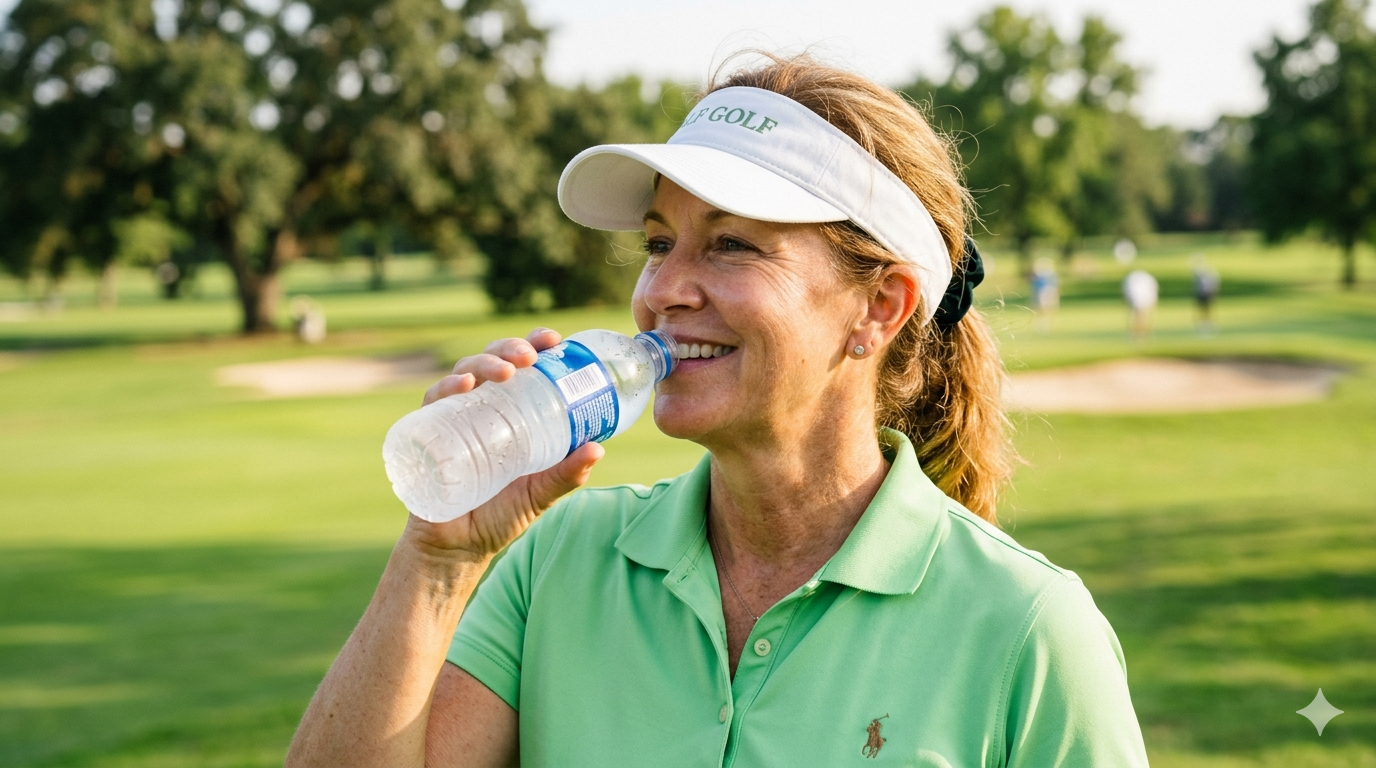
You don’t need to be playing in blazing heat to finish a round running on empty. Here’s how to drink smarter this summer.
Four or five miles on foot. Clubs to carry or push. Shot after shot demanding concentration when your legs are already tired. Golf asks more of your body than most rounds feel like they do — and in summer, even a mild warm day is enough to tip you into a deficit before you reach the turn. The problem isn’t that golfers don’t know hydration matters. It’s that the game makes it easy to forget.
Golf dehydrates you faster than you think
The maths is simple enough. Walking 18 holes typically covers four to five miles, and when you add in the stop-start nature of the game — carrying a bag, pushing a trolley, swinging repeatedly — your body is working continuously for three to five hours. In warm weather, you’re losing fluid the entire time.
The issue is that golf doesn’t feel like hard exercise. You’re not red-faced and breathless the way you might be after a run. The exertion is steady and low-level, which means the cues that normally remind you to drink — heavy sweating, obvious thirst — are easy to miss or dismiss. By the time you’re thirsty, you’re already one to two percent down on fluid, which is enough to affect your game.
Aim to arrive at the course already hydrated. That means drinking steadily through the morning before you tee off, not downing a pint of water in the car park ten minutes before your round.
Links courses: a special mention
If you play links golf, dehydration deserves extra attention. Coastal courses are typically exposed, with little tree cover and persistent wind — and it’s that wind that catches people out. Evaporative cooling means you lose moisture from your skin faster in a breeze than in still air, without the obvious cues of sweating heavily. You can walk a links on an overcast day feeling perfectly comfortable and still finish significantly dehydrated. If the sea breeze is up, drink more than you think you need to.
The signs you’re already behind
Thirst is a lagging indicator — by the time you feel it, you’re already playing catch-up. The early signs of mild dehydration are subtler, and most of them look like bad golf.
Watch for: club selection that starts to feel harder to commit to; concentration that frays on putts you’d normally back yourself on; a short fuse on the back nine when a shot goes wrong. A headache on the drive home, or persistent tiredness after a round, are also common signs you didn’t drink enough.
Urine colour is the simplest check: pale yellow means you’re well hydrated; dark yellow or amber means you’re not. It’s not glamorous, but it works.
A simple drinking plan for 18 holes – You don’t need a spreadsheet. A rough framework to aim for:
- Before you play: 500ml of water in the hour before your round.
- During the round: aim for 150–200ml every two or three holes — roughly a few good gulps. Don’t wait until you’re thirsty.
- At the turn: a proper drink, not a sip. If it’s hot or windy, this is the moment to catch up.
- After the round: rehydrate before the 19th. Alcohol on a dehydrated body hits harder and slows recovery.
On electrolytes: if you’re playing 18 holes in genuine heat, or you know you’re a heavy sweater, adding an electrolyte tablet to your water is worth it. They replace sodium and other minerals lost through sweat, which plain water doesn’t. For cooler days or a casual nine holes, water is fine.
What to eat to help

Food contributes more to your hydration than most people realise — around 20 percent of daily fluid intake comes from what you eat. Snacks with high water content are a useful complement to drinking, and they happen to be good golf food: easy to carry, quick to eat between holes.
Good options to pack: sliced cucumber (around 96 percent water), orange segments, grapes, or a small pot of melon. At the turn, a banana adds potassium alongside fluid. What to avoid: salty snacks or crisps that increase thirst without helping hydration, and anything heavy that slows you down on the back nine.
One practical tip: freeze your water bottle the night before and let it thaw in your bag. It stays cold for much of the round, and cold water is easier to drink consistently than warm.
Hydration isn’t complicated, but it’s easy to let a round slip by without drinking properly. Get it right and you’ll notice it most on holes 14 to 18, when everyone else’s game starts to unravel and yours doesn’t.


