


New figures from Arccos covering nearly 10 million tee shots reveal what female golfers of every age and handicap are really hitting — and where distance is, and isn’t, the issue.
Women’s aggregate average driving distance is 175.7 yards, according to the 2026 Arccos Annual Driving Distance Report — down fractionally from 179.2 yards in 2018, and broadly flat across eight years of data. That stability tells a story in itself. While much of the distance conversation in golf centres on the men’s game and the professional tour, the real-world picture for women amateurs is one of remarkable consistency, with skill and age shaping performance far more than any trend over time.
The report draws on nearly 10 million driver tee shots recorded during the 2025 calendar year by Arccos members worldwide, making it the largest on-course amateur dataset of its kind.
Distance: where handicap matters more than age
The women’s distance data by age and handicap covers golfers in their 20s through to their 60s. Women in their 20s average 201 yards off the tee; by the 60s that falls to 158 yards — a 43-yard gap across the full age range, representing a 27% decline. That gradient is consistent across every handicap band, which tells us that losing distance with age is not a skills problem. It is simply physics.
What is more instructive is how much handicap influences distance, and by how much more than age alone. Among women, scratch to 4.9 handicap players average 220 yards; those at 30-plus average 145 yards — a gap of 75 yards, or 52%. The same pattern holds for men, but the women’s gap is larger in percentage terms. A low-handicap woman in her 40s (averaging 232 yards) is hitting it significantly further than a high-handicapper in her 20s (168 yards). Distance, in other words, is primarily a skill metric, not an age one.
Accuracy: the finding that challenges the conventional wisdom
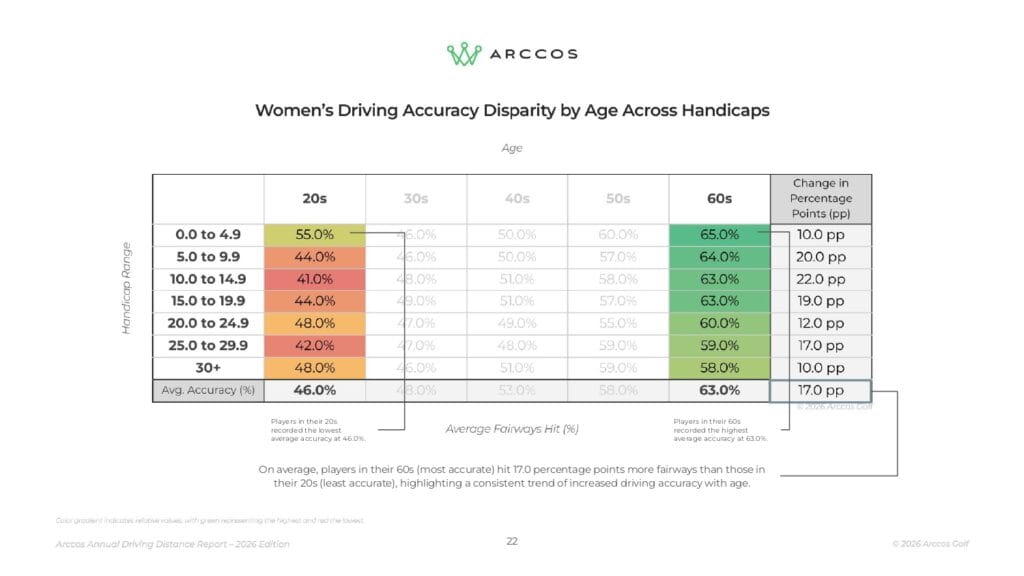
Perhaps the most useful finding for women golfers is around accuracy — and it upends the idea that hitting it shorter means hitting it straighter. Among women, the difference in fairways hit between the best and worst handicap groups is just two percentage points. Scratch to 4.9 handicap women average 55% fairways hit; those at 25 to 29.9 average 51%. That is not a meaningful gap. Unlike in the men’s game — where low-handicappers hit significantly more fairways — women’s driving accuracy shows no significant correlation with handicap. High-handicap women are not spraying it offline at a rate that compounds their distance deficit.
What does improve consistently with age is accuracy. Women in their 20s hit 46% of fairways on average; by the 60s that rises to 63% — a 17 percentage point improvement. That mirrors the men’s trend almost exactly (18 percentage points) and reinforces that experience, patience, and swing tempo all contribute to straighter driving over time. For any woman in her 40s or 50s concerned about losing distance, the data offers a useful reframe: she is almost certainly gaining something valuable in exchange.
What this means in practice
For women golfers looking to improve their scores, these findings point firmly towards distance over accuracy as the primary driver of handicap reduction. The data shows clearly that the biggest performance gap between women is yardage off the tee, not fairways hit — and that a more aggressive approach to distance through fitting, technique, or equipment is likely to yield more improvement than chasing a higher fairways percentage.
The overall picture is of a game where women’s driving performance has been stable for the better part of a decade, shaped primarily by skill level, and where getting longer — not simply straighter — is what separates a 10-handicapper from a 4.
Source: Arccos Annual Driving Distance Report 2026 Edition, based on data from the 2025 calendar year.


