


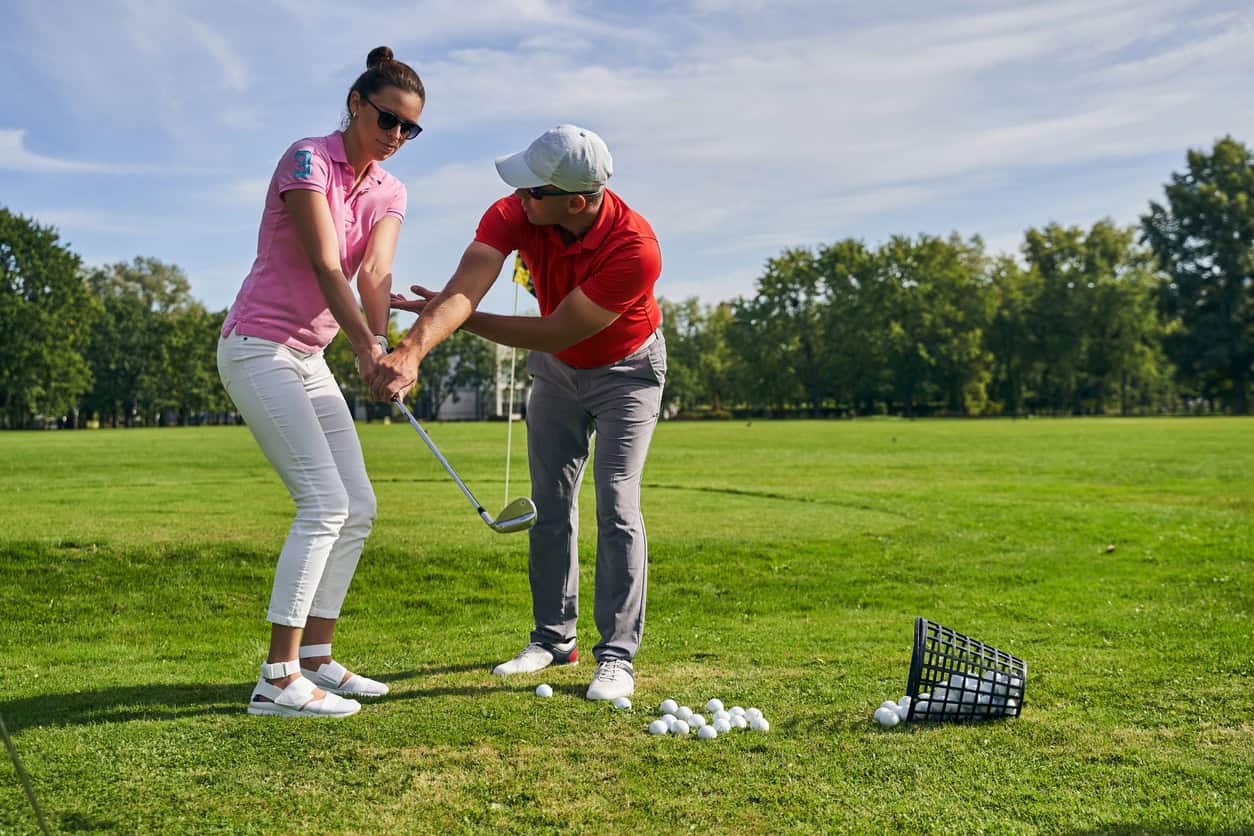
Golf is supposed to be enjoyable. If yours isn’t quite there yet, coaching is almost certainly the fastest way to change that — and it’s probably less daunting than you think.
Most women who find golf frustrating aren’t doing anything dramatically wrong. They’re repeating a handful of small habits that compound over 18 holes into something that feels like hard work. The problem isn’t lack of effort or lack of interest. It’s that without someone qualified to spot what’s actually happening, those habits become permanent. You play the same round on a slightly different course, week after week, and wonder why nothing is changing.
Coaching breaks that cycle. It is, straightforwardly, the fastest route from golf that feels like a struggle to golf that feels like the thing you wanted it to be.
Why most golfers stay stuck without it
There’s a particular pattern that a lot of women golfers will recognise. You play, you have some good holes and some bad ones, you try to remember what you did differently on the good ones, and you attempt to replicate it. Occasionally it works. Mostly it doesn’t, and you’re not entirely sure why.
This isn’t a personal failing — it’s what happens when you’re trying to diagnose and fix your own swing without the tools to do either. A good coach watches you hit five balls and sees things you would never identify yourself: a grip that’s slightly off, a set-up that compensates for something, a weight transfer that works against you at the point of impact. None of these feel wrong to you. They feel completely normal, because you’ve been doing them for years.
That’s what coaching addresses. Not your enthusiasm or your commitment, but the specific mechanical habits that are making the game harder than it needs to be.
What coaching actually does at this stage
It’s worth being clear about what you’re trying to achieve, because that shapes the kind of coaching you need and the number of lessons that makes sense.
At this stage, you’re not trying to rebuild your swing from the ground up or qualify for anything. You want to make more consistent contact, feel less anxious on the first tee, stop losing balls to the same recurring shot, and generally spend more time enjoying the round and less time managing frustration. That’s a realistic and achievable goal. It also doesn’t require years of intensive work.
A good coach will focus on the two or three things that will make the biggest immediate difference to how the game feels. Not everything at once — that’s overwhelming and counterproductive. The most effective coaching at this stage is targeted, practical, and focused on results you can actually feel within a few rounds.
How many lessons do you actually need
One lesson will not fix anything permanently. That’s not a sales pitch for an expensive package — it’s just how motor learning works. A single session can give you something useful to work on, but one lesson followed by nothing is rarely enough for change to stick.
Equally, you do not need to commit to 20 lessons before you know whether it’s working. A sensible starting point is a block of four to six lessons, spaced roughly two to three weeks apart. That gives you enough time between sessions to actually practise what you’ve worked on, and enough continuity for the coach to track your progress and adjust the focus as you improve.
After that block, you reassess. Many women at this stage find that four to six lessons, plus some time playing, shifts things significantly. Others continue with monthly check-ins rather than intensive coaching. There’s no single right answer — but don’t let anyone tell you it has to be an open-ended commitment.
One-to-one or group lessons
Both have genuine merit here, and group lessons are worth considering seriously — particularly if cost is a factor or if you respond well to learning alongside others.
One-to-one coaching gives you focused, personalised attention. Every observation and adjustment is specific to you. It’s the most efficient route if you have a specific problem to solve or if you know you find it hard to concentrate in a group setting.
Group lessons — typically two to four players — cost considerably less per session and have a social element that many women find actively helpful. Watching someone else work through a problem, and recognising it in your own game, is a genuinely useful learning tool. Many clubs run women’s group coaching sessions, and for someone at this stage they can be an excellent and confidence-building place to start.

The one caveat: make sure any group you join is genuinely matched in level. A mixed-ability group where you’re significantly behind the others is uncomfortable and counterproductive.
How much do you need to practise
Honestly — some, but probably less than you think.
Coaching without any practice at all still produces improvement, particularly at this stage, because the adjustments a good coach makes to your set-up and technique will carry into your game simply through playing rounds. You don’t need to be on the range for an hour every week for coaching to be worthwhile.
That said, even 20 minutes on a practice net or at a driving range between sessions makes a meaningful difference to how quickly things bed in. If you genuinely have no time to practise, tell your coach. A good one will factor that into what they ask you to work on between lessons rather than setting you up to fail.
How to find the right coach
Start with the PGA’s Find a Coach tool at PGAPlay — it lets you search by location and shows you qualified professionals in your area. Every coach listed is PGA qualified, which is your baseline assurance of professional training and accountability.
From there, look for someone who has genuine experience teaching women, and ideally someone who teaches across a range of levels rather than working exclusively with low-handicap or competitive players. A coach who mostly works with scratch golfers may be technically excellent but less well-suited to where you are right now.
One practical step worth taking: look at the coach’s website or social media before you make contact. Does it feature women golfers? Does it talk about enjoyment and confidence as well as technique? Does it feel like somewhere you’d be comfortable? First impressions from a website are imperfect, but they’re not nothing.
When you make contact — by phone or email — notice how they respond. Are they interested in what you’re trying to achieve, or do they just tell you when they’re available? A coach who asks what you’re looking to get out of lessons before you’ve even booked is already showing you something useful.
What the first lesson should tell you
You should leave the first lesson with something specific and useful to work on. Not a list of everything that needs fixing — one or two things, clearly explained, that you understand and can actually take onto the course or to the range.
You should also leave feeling that the coach listened to you, watched you carefully before they said anything, and explained their thinking in plain language rather than technical jargon. The best coaches are patient communicators. They make you feel capable, not grateful.
If you felt rushed, talked at, or came away with a long list of problems and no clear sense of priority, trust that instinct. Not every coach is the right coach for every golfer. It is completely reasonable to try someone else.
The goal, after all, is simple: golf that feels the way you wanted it to feel when you started. The right coach is the one who gets you there.
Find a qualified PGA coach near you at PGAPlay
Ready to take your golf further? Read our guide to How to find the right golf coach and get the most out of working with one


