



Shot Scope’s analysis of nearly a million rounds reveals that lower scores come from avoiding mistakes, not making more birdies — and several findings are particularly relevant to how women approach the game.
If you’ve ever walked off the 18th feeling like your putting let you down, or told yourself that a few more yards off the tee would transform your game, a new data report from Shot Scope makes for instructive reading.
The GPS and performance tracking brand has published its Annual Golf Performance Report, drawing on 74 million shots across more than 870,000 rounds played in 2025, across 24,000 courses worldwide. The data covers the broader amateur game rather than women specifically, but several of its central findings map directly onto how many women golfers already experience the game — and challenge some assumptions worth examining.
The scorecard doesn’t tell the whole story
The average score among Shot Scope users is 86.4. Most rounds cluster in the mid-to-high 80s, with relatively few falling significantly above or below that band. Breaking 90 is common — three-quarters of users managed it — but fewer than a third broke 80. Below 70 is almost vanishingly rare.
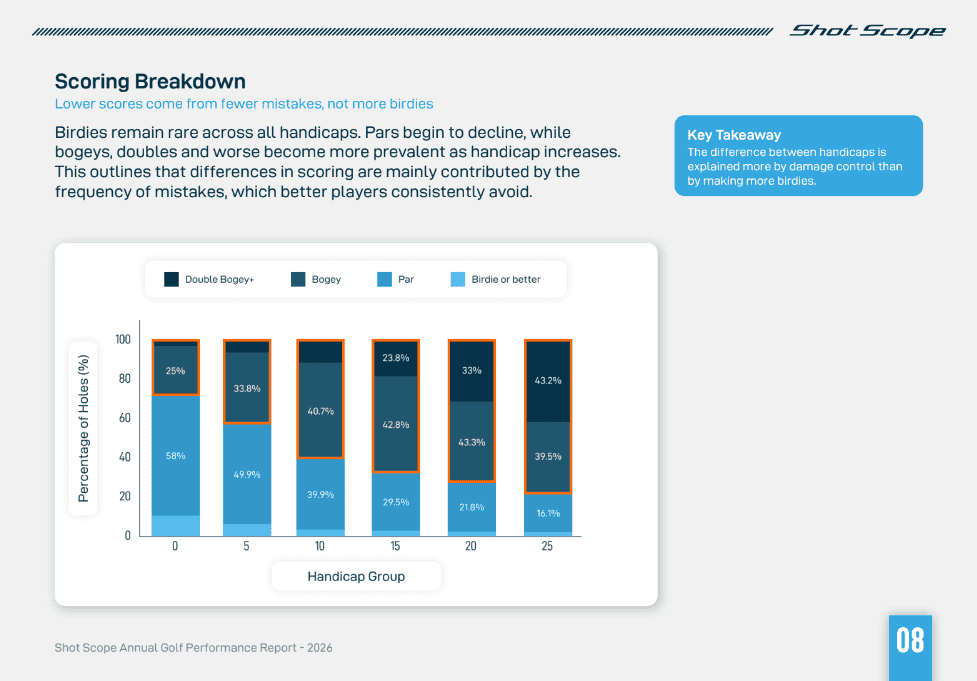
The critical insight is what separates those scoring bands. It isn’t birdies. At every handicap level, birdies remain uncommon. What changes as handicap rises is the frequency of bogeys, double bogeys and worse. The players who score better aren’t making more spectacular shots — they’re making fewer costly ones. Damage limitation, not brilliance, is the engine of lower scores.
Par 5s are where handicap groups diverge most sharply. Better players treat them as birdie opportunities; higher handicappers find them the most penalising holes on the card, largely because their length amplifies every error that came before. Par 3 difficulty, interestingly, remains broadly constant across all skill levels.
Off the tee: consistency beats distance
Distance is the obsession of many amateur golfers, and the report confirms that lower handicappers do hit it further. But the overlap between groups is significant — a well-struck drive from a 15-handicapper will often travel further than the average drive of a 10-handicapper. The report’s concept of “Performance Average” — the distance a player hits when they make good contact — illustrates the point neatly. The gap between a player’s typical drive and their well-struck drives is larger than the gap between handicap groups.
This is a finding that resonates particularly for women golfers, who are often told — implicitly or directly — that distance is their limiting factor. The data suggests otherwise. Most players already have enough distance to score better than they do. The question is how consistently they’re using what they have.
Tee shot dispersion is also more consistent across handicaps than many assume. Better players don’t hit dramatically tighter — they reduce the frequency of the biggest misses. And when those big misses happen, the penalty isn’t just a poor lie: missed fairways result in longer approach shots, which compounds difficulty for everyone, but particularly for players who are already challenged by distance into greens.
Hitting the fairway matters primarily because it limits downside. The data shows a notable difference in average score to par between fairway hits and misses. A good tee shot doesn’t guarantee a birdie — but it protects you from a cascade of errors.
Approaches: you’re further away than you think
Higher-handicap players don’t just struggle more with approach shots — they face harder ones to begin with, consistently playing into greens from longer distances. Green-in-regulation rates fall sharply as approach distance increases, and this applies at every skill level. No golfer is immune to the difficulty of a long approach.
Lie compounds the problem. Finding rough or a fairway bunker off the tee significantly reduces GIR regardless of handicap. The clear takeaway: fairway bunkers should be avoided at virtually any cost. Interestingly, scratch golfers experience one of the largest GIR penalties when playing from them — a reminder that no one handles sand off the fairway particularly well.
From 150 yards, a scratch golfer averages around 40 feet from the pin; a 25-handicapper averages around 70 feet. That gap isn’t just about iron-striking — it’s about where the ball finishes relative to the flag when the green is missed. Better players miss greens in more recoverable positions. That proximity advantage carries forward into the next shot.
One finding that applies across the board: roughly 40% of wedge shots from 100 yards finish short of the green, at every handicap level. Under-clubbing with the wedge — or underestimating carry — is a universal habit. For women golfers playing in cooler conditions or into a breeze, where carry distances can shift significantly from range expectations, the case for taking an extra club is compelling.
Short game: it’s not the putter’s fault
The short game section may be the most useful in the report for anyone looking to understand where shots disappear. From 50 yards, all golfers — including scratch players — are more likely to take three or more shots to finish the hole than to achieve an up-and-down. Missed greens rarely produce easy saves.
Up-and-down success drops sharply as distance from the pin increases. The most important factor is not technique or even club choice — it’s proximity. Every yard closer to the flag materially improves save percentages. And from 30 yards, most amateurs leave themselves well outside realistic one-putt range, which means the putter is being asked to do a job that the chip shot already lost.
Club selection is also worth examining. The data shows that most amateurs default to lob and sand wedges inside 50 yards, largely out of habit. Lower-lofted options consistently produce higher save rates when conditions allow — and the putter, used from off the green where lie and terrain permit, produces the highest save percentages of any club. Reaching for maximum loft is rarely the percentage play.
On the green, make rates drop sharply beyond six feet at every handicap level. A 15-handicapper sees success rates fall by more than 40% between short putts and mid-range ones. Expecting putting to compensate for a chip left 25 feet away is optimistic at best.
What this means for how you practise
The cumulative message from the data is clear: improvement comes from reducing the cost of mistakes, not from eliminating them entirely. Fairways matter more than extra distance. Approach distances matter more than approach precision. Chip proximity matters more than putting. And avoiding the worst outcomes — fairway bunkers, big misses, short-sided chips — has more impact on your scorecard than any single highlight shot.
For most golfers, the most valuable practice session isn’t working on launching it further. It’s spending time on wedge carry distances, chipping to proximity targets, and building a consistent tee shot that keeps the ball in play. None of those things require exceptional power — they require attention, repetition and honest self-assessment.
–


