

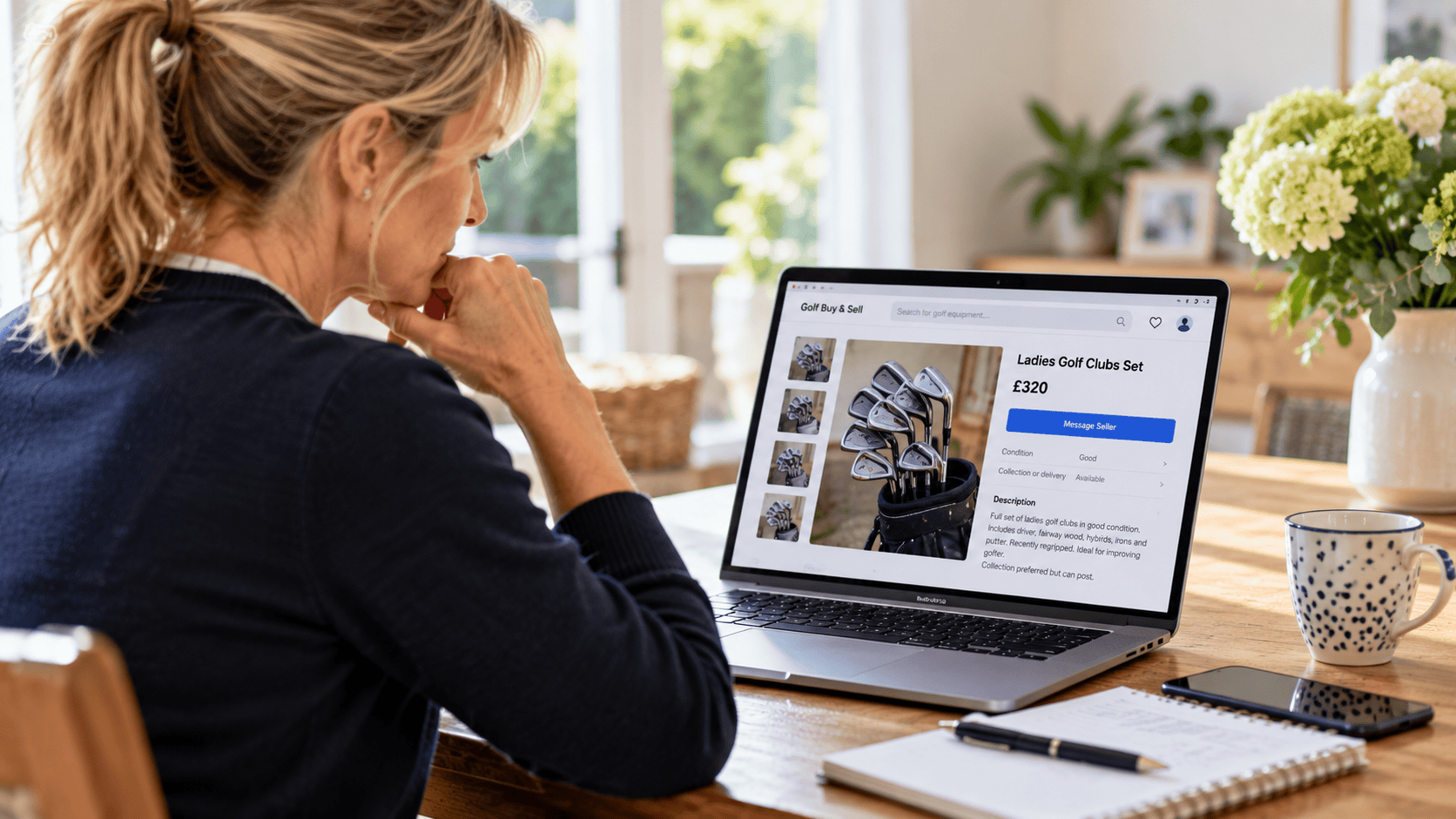
A tempting price is only part of a private club purchase. Check the seller, the transaction and the actual equipment before committing your money.
The photographs look promising. The price is comfortably below the other sets you’ve seen, and the seller says someone else is interested. A quick deposit will secure them.
That is the moment to slow down.
Buying privately can be a good way to find affordable clubs, whether you spot them in a classified advert, on Facebook or through an online marketplace. But before worrying about whether the irons will suit your swing, there is a more basic question: will you receive the clubs you’re paying for?
A convincing advert is only the beginning of the checking.
Don’t pay to hold clubs you haven’t seen
MoneyHelper warns about sellers who ask for a deposit to reserve an item, then disappear. Pressure from an alleged competing buyer can make a sensible check feel like a risk of missing out.
For a direct local sale, arrange to see the clubs and inspect them before paying. Meet safely in a well-lit public place; taking someone with you also gives you another pair of eyes. If the seller keeps finding reasons why you cannot see the goods but wants money immediately, leave the deal alone.
A posted purchase is different. You will usually have to pay before dispatch, so establish what protection applies before committing. A promise in a message is not the same as a payment service’s published buyer-protection terms.
There is nothing about a set of golf clubs that makes it worth rushing past uncertainty over whether the seller has them.
Where you find the advert isn’t the whole story
An eBay listing, a classified advert and a Facebook post may all show the same model of driver. The buying arrangements can be quite different.
eBay’s Money Back Guarantee covers eligible purchases when an item does not arrive or does not match its listing, subject to its conditions and deadlines. It excludes transactions where any part of the payment is made outside eBay. A seller asking you to switch to a separate bank transfer is therefore asking you to change more than the payment method.
With a direct private sale, establish who you are dealing with, how the clubs will reach you and what happens if there is a problem. Don’t assume that the website carrying an advert will handle a dispute or refund your money.
Also distinguish a business selling used equipment from an individual selling their own clubs. Citizens Advice explains that private sales do not carry the same general 14-day change-of-mind period as online purchases from businesses. Goods must still match their description; simply finding a genuine, accurately described club difficult to hit is a different issue.

A familiar logo doesn’t settle authenticity
Counterfeit clubs are another risk, separate from a seller taking payment and sending nothing.
Callaway’s published warning describes buyers receiving fakes advertised as authentic products. It recommends caution over implausibly low prices and contacting the manufacturer for assistance if authenticity is in doubt.
Ask for clear photographs of the actual clubs. Stock images cannot show the condition of the set being sold. Ask where the clubs came from and whether the seller has a purchase receipt, while recognising that paperwork and a plausible explanation are not guarantees.
Be wary of trying to settle the question from a logo, one photograph or a number alone. If you are still unsure about an expensive purchase, a more identifiable seller with clear terms may be worth the extra cost.
“Ladies’ clubs” is not a complete description
Once the sale itself looks credible, check exactly what is being offered.
“Ladies’ irons, good condition” leaves plenty unanswered. Which model? How many clubs? What shaft is fitted, what flex is marked on it, and have the clubs been shortened, lengthened or reshafted?
Ask those questions before making an offer. A seller may be entirely honest without knowing the specification: “They belonged to my mother” explains ownership, but tells you little about the clubs.
For an iron set, request photographs of each club number and the shaft labels. For a driver, confirm the model and loft and whether the sale includes the complete club or only the head. These details are easier to resolve while you still have a choice about buying.
Our guide to buying second-hand clubs covers suitability and condition in more detail. With a private listing, the task is to get the information that a broad description leaves out.
Check what the photographs leave out
Ask to see the faces, soles, shafts and grips, rather than accepting one photograph of clubs standing in a bag. Ask directly about repairs, damage and alterations.
If collecting, compare the actual clubs with the advert before handing over money. If having them posted, keep the listing and messages, including answers about condition, specification and what is included.
Before paying, be able to answer five questions:
- Who is selling?
- What exactly am I buying?
- What have I been able to check?
- How will I receive it?
- What protection applies if the sale goes wrong?
A genuine private seller does not have to offer a shop’s service. But you do need enough information to make the purchase sensibly. If getting that information is becoming a struggle, there will be another set of clubs.
Links to affiliate Partners: – Callaway Pre-Owned US – Callaway Pre-Owned UK/EU – Global Golf US


