

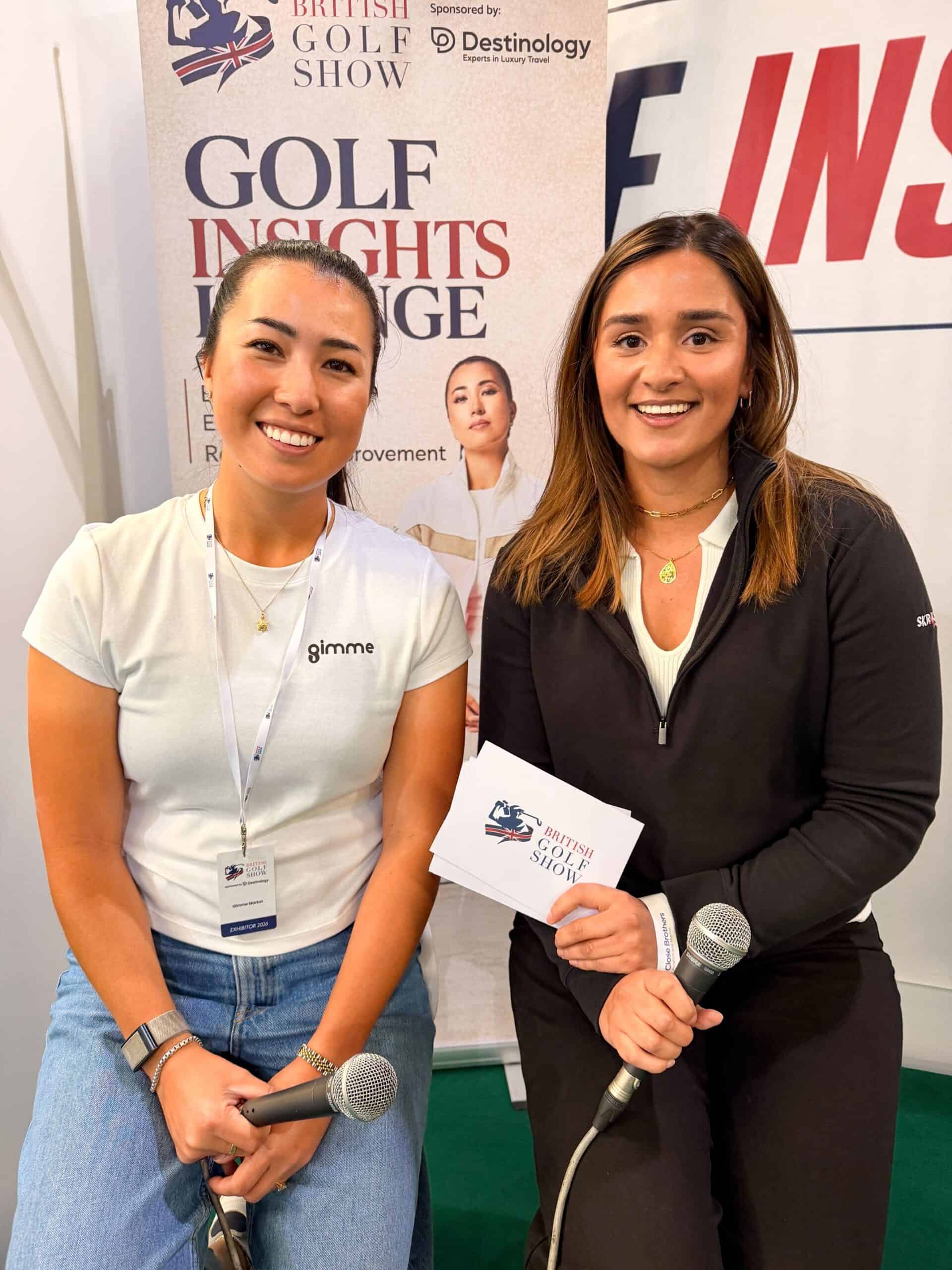
She turned professional at 18, competed on the Ladies European Tour, and rebuilt her career from scratch in front of the cameras. Now Inci Mehmet — Sky Sports broadcaster, ambassador and entrepreneur — is doing it all over again. Caroline Shukla caught up with her at the British Golf Show.
You started playing golf at four years old. Was that your mum’s idea?
Honestly, I still scratch my head asking myself that same question. My mum is Korean, my dad is Turkish — nobody in my family plays golf. But my mum was a single parent and she just threw everything at me. She grew up playing different instruments, trying every sport she could find, and she understood her own strengths and weaknesses. She knew she wasn’t the expert, so she made sure to surround me with the right people and the right coaches. Without her, none of it happens.
You became the youngest ever ladies’ club champion at Wentworth at just 15. What was that environment like for a teenager?
It was an amazing place — incredibly prestigious — and as a junior scholar I had access to fantastic coaching and facilities. But I’d be lying if I made it sound glamorous. My mum still had to drive me 45 minutes each way and sit in the car for hours until it got dark. Eventually I felt I couldn’t keep asking her to do that, so I moved on. I’m still involved with Wentworth now, though — when the BMW PGA Championship is on, I help bring juniors into the production area. Last year, when Shane Lowry made that incredible second shot on 18 and the crowd went wild, the juniors were right there watching the directors, the commentators and the cameras all react in real time. Money genuinely cannot buy that kind of experience.
You turned pro straight from school and earned your LET card in 2016. What’s the biggest challenge you found on tour?
Comparison. I wish I’d stopped comparing myself to other players so much. As an amateur it almost doesn’t matter — you’re playing for the love of it. But once it’s your profession and your livelihood, you start measuring yourself against everyone else, and for me that was really tough. I’m friends with Lydia Ko now, and I said to her jokingly: “You’re kind of the reason I quit.” You’re standing next to someone who has won multiple majors, been inducted into the Hall of Fame, and shot 59 — and you think, well, where does that leave me? It’s a form of imposter syndrome, and looking back, I wish I’d been much kinder to myself.
You retired in 2020, partly due to injury. Was that a difficult decision?
It was. I had tendonitis in both wrists and a bulging disc in my back. I know that sounds like I’m about 80, but I was in a genuinely terrible way physically and I couldn’t rely on my body to make a living any more. You only live once — and I didn’t want to keep going just because I’d always assumed that was the path. Someone told me at the time that the destination is the same, it’s just the journey that’s changing. It was still a hard thing to accept. My mum had sacrificed so much. But I’ve never had any problem being honest with myself, and being honest with myself was the only way forward.
Sky Sports wasn’t exactly the plan. How did that start?
It really wasn’t. My agent had a good relationship with Sky and managed to get me into the studio — and I hated it. My heart was pounding, there were huge cameras pointing at me, an earpiece with the producers talking in my ear, and when Sarah Stirk asked me perfectly simple questions during rehearsals I couldn’t string a sentence together. The more nervous I got, the faster I talked, and the less I could think. I was convinced they’d never invite me back. But thankfully they did. The thing is, I’d been a student of the game my whole life — I had a lot to share, I just had to find a way to actually get it out of my mouth.
You do everything at Sky — punditry, analysis, on-course commentary, presenting. What’s the role you’ve found most natural?
Every single role has a very different skill set, and I think that’s what I love about it. In the studio I started as a pundit — I didn’t even know what a pundit was when I began, because I’d never really watched sport growing up. Then I moved into analyst work with the touchscreen, which I love — I’m a bit of a tech gadget fan. Then on-course commentary, which is a completely different discipline. When you’re out there as an encoarser, your job is to describe what the viewer at home cannot see: the smell of the sausage rolls halfway up the hill at the Belfry, the noise of the crowd, the feel of the occasion. It’s not about what’s happening on screen — it’s everything around it.
You’ve worked alongside some of the biggest names in golf. Who is the best interviewee?
Rory McIlroy, without a doubt. As a presenter you can ask him a short, simple question and he will take the mic and essentially do your job for you — in the best possible way. You can hear him thinking as he answers. The words are considered, the insights are genuine. That is such a gift when you’re working live. There are others who give you one-word answers and you’re sitting there trying to work miracles with the follow-up — but I couldn’t possibly say who.
You’ve recently co-founded Gimme, a marketplace for second-hand golf equipment. Where did that idea come from?
It came from a very personal place. When I was young, my mum had to sell some of her jewellery to buy my first set of clubs. Golf is an expensive sport, and I always thought: if there’s anything we can do to make it more accessible, we should try. The second-hand market for golf equipment is massive — but it’s also a mess. Selling is a hassle, buying involves either trusting a stranger online or getting lost in a wall of technical jargon you don’t understand. Gimme is trying to solve both sides of that. We handle the logistics. We have a help-to-choose tool for people who don’t know what they need. And we work with pro shops so there’s a tier of Gimme-approved listings — verified condition, reliable delivery — alongside individual sellers. The app has been live for just under a month. We’re very much at the beginning, but the bones of it are really exciting.
You’re contracted to Sky for 22 weeks a year. Is the rest of the time going into Gimme?
Pretty much, yes. It’s either Sky or Gimme — there’s not much else. I’d always known I wanted something of my own, so when the opportunity came I grabbed it. I co-founded it with my fiancé, which means our dinner table conversation is basically a board meeting, which is very consuming — but honestly, I wouldn’t want it any other way. The biggest lesson so far has been trust. You build a team, you have to let them do what they do. The instinct is to have your hands in everything — you’re wearing every hat at once — but you have to learn to step back and bucket people into what they’re good at. I’m still learning that.
QUICK FIRE
- Lowest round? 64 at Royal Birkdale Women’s — and I hold the course record.
- Favourite club in the bag? Driver. All day long.
- One course, forever? St Andrews — the Old Course. I played there in 2015 with Tiger Woods, I’ve worked the Open there with Sky, and a couple of weeks ago I played there again with Andy Murray. Every single time, it feels magical. When you walk down 18 and look back into the town, it’s almost spiritual.
- Hole in ones? Zero. Absolutely zero. And yes, I’m very sensitive about it.
- Dream fourball? Tiger Woods, Rory McIlroy — and Seve Ballesteros. I never had the chance to meet Seve, but the impact he had on the game is extraordinary. His son Javier is a very cool guy and carries that legacy brilliantly. That would be some round.
Gimme is available to download now. Search ‘Gimme Golf’ in the App Store or Google Play – links at the Website
This interview was conducted at the British Golf Show by Caroline Shukla, founder of Skratch Women — an award-winning women’s golf community based in London. Find out more at skratchwomen.com


