


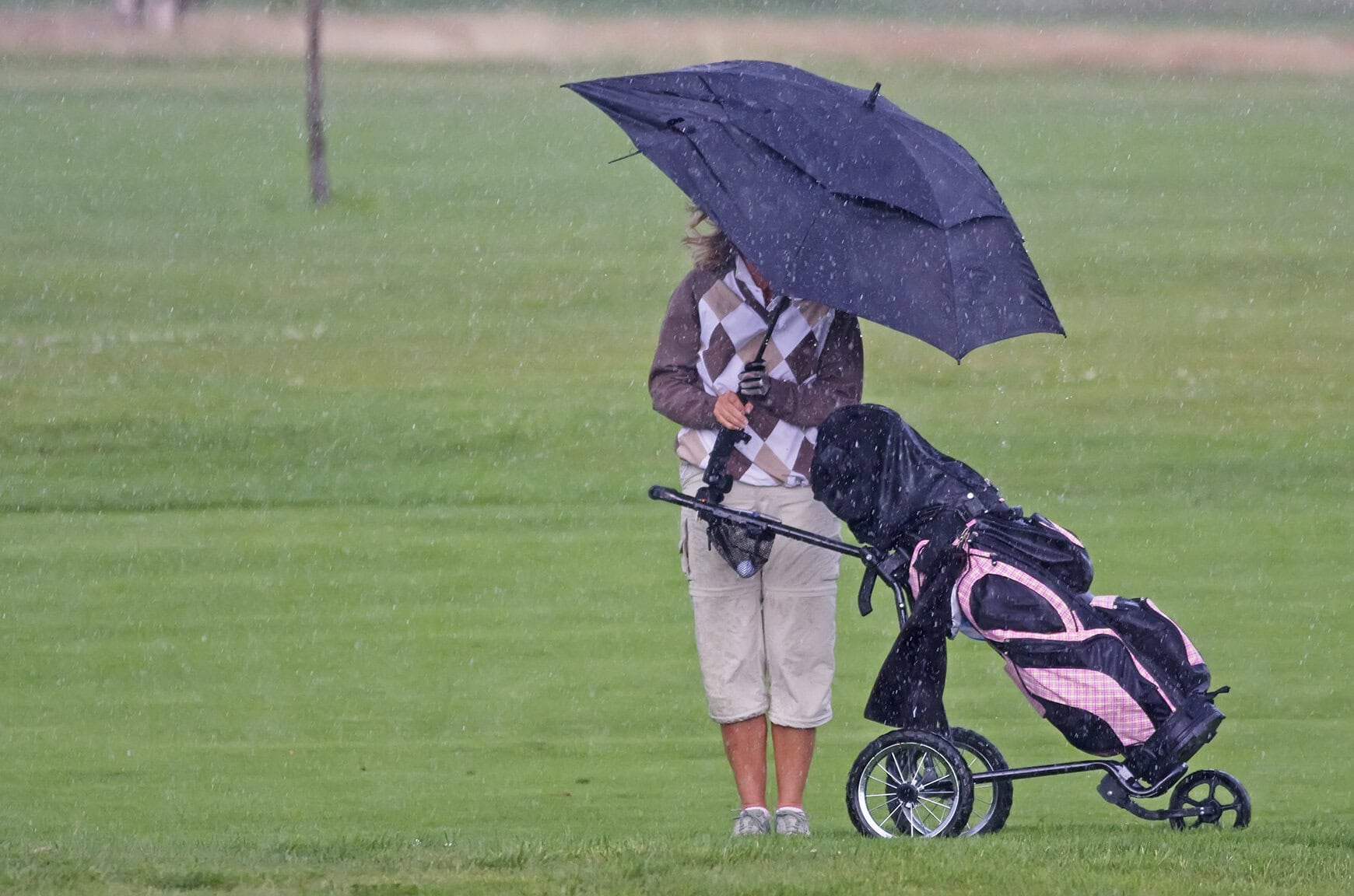
After a dry summer, sudden heavy rain is leaving standing water across UK courses — in fairways, bunkers and on greens. This piece explains exactly what relief you’re entitled to when your ball or your stance is affected by temporary water, covering the general area, bunkers and the putting green, with PGA Professional Hannah Davies demonstrating the process for England Golf.
A hot, dry summer followed by heavy rain is a familiar British combination — and it’s a bad one for drainage. Hard, compacted ground can’t absorb sudden downpours quickly, so puddles sit on the surface for hours or days rather than draining away. If your ball comes to rest in one, or you have to stand in one to play your next shot, you’re not stuck. You’re entitled to free relief. Here’s how it works.
WHAT THE RULE SAYS
Temporary water is defined as any temporary accumulation of water on the ground that isn’t in a penalty area — most commonly puddles left by rain, irrigation, or overflow. It’s classed as one of golf’s abnormal course conditions, which means the rules don’t treat it as part of the normal challenge of the course. You get free relief if your ball touches or is in temporary water, or if the water physically interferes with your stance or your swing.

THE ANSWER
Where you are on the course determines exactly how you take relief.
In the general area (fairway or rough), find the nearest point of complete relief — no nearer the hole — then measure one club length from that point using your longest club. Drop the ball within that area from knee height. No penalty.
In a bunker, you have two free options and one paid one. You can drop within the bunker at the nearest point of complete relief, one club length, no nearer the hole — still no penalty. If the bunker is completely flooded with no dry ground available, you can take maximum available relief within the bunker for no penalty, dropping in the shallowest remaining water no nearer the hole.
Or, if you’d rather get out of the bunker altogether, you can take relief on a line straight back from the hole through where the ball lay, dropping outside the bunker —but this carries a one-stroke penalty.
On the putting green, relief is free and straightforward: find the nearest point of complete relief, no nearer the hole, and place the ball there. This can sometimes mean placing your ball just off the green if that’s the nearest dry spot.
There’s one line-of-play situation worth knowing too. If your ball is on the green and temporary water sits on your line to the hole, you get free relief from that as well — even if the water itself is off the green. But it doesn’t work in reverse: if your ball is off the green and temporary water is on the green itself, sitting on your line, you are not entitled to relief.
Key Takeaway
The habit worth building is simple: find the nearest point of complete relief first, then measure your one club length from there — not from where your ball is now. Rushing this step is the most common way golfers end up dropping in the wrong place. In a flooded bunker, don’t assume you have to play it as it lies; check whether the bunker qualifies as completely flooded before deciding between your free options and the one-stroke penalty route.
England Golf — “Temporary Water | Rules of Golf” featuring Hannah Davies.

Read More: No-Play Zones Explained: What to Do When Your Ball Is Out of Bounds


