

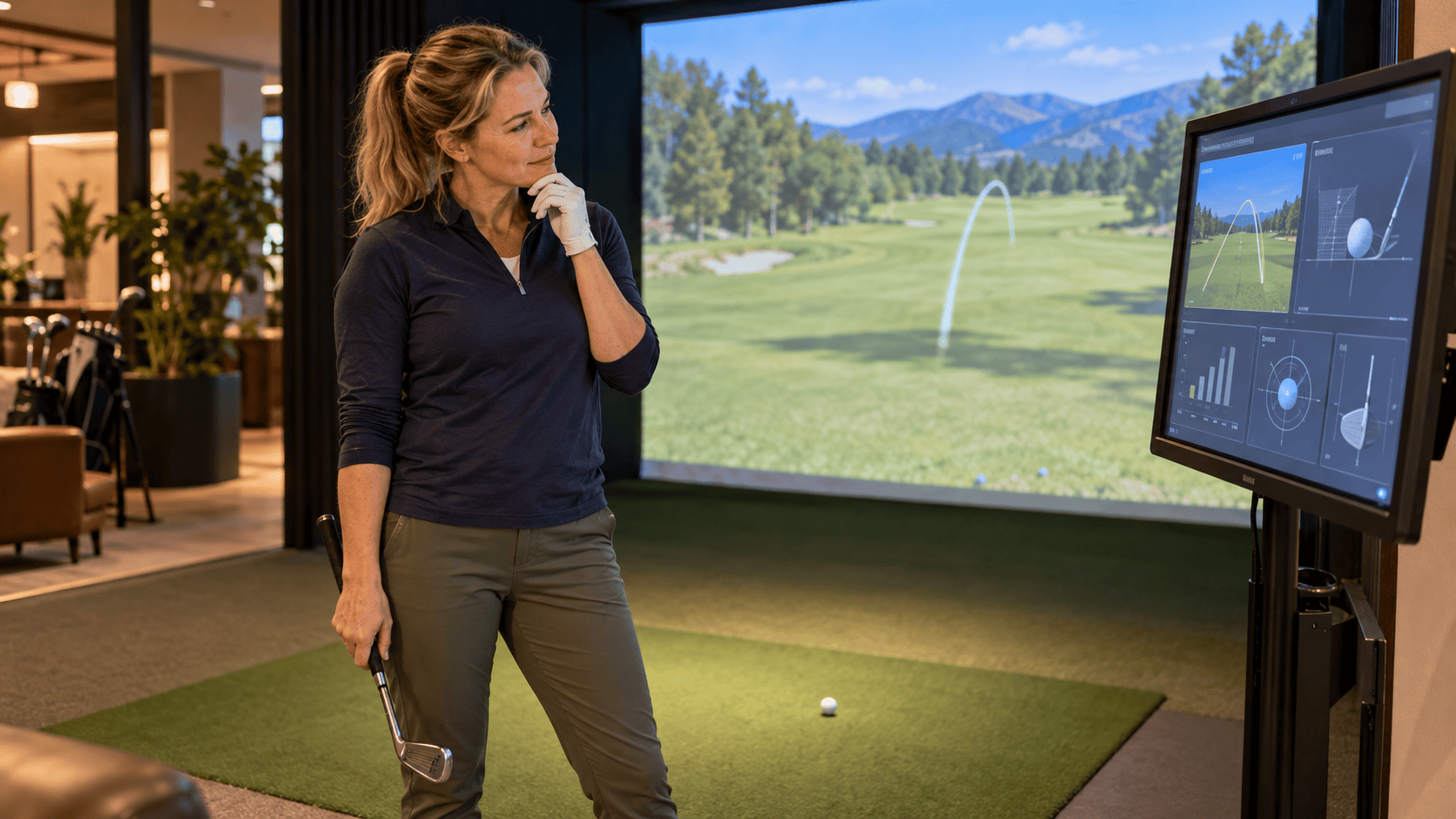
A screen full of figures can make an indoor golf session feel like a maths lesson. For your first visits, a few simple readings are enough to help you understand your shots.
You hit a ball, watch it fly across the screen and turn to find a list of numbers. Carry, total, ball speed, club speed… which one should you look at?
Start by asking the person setting up your session to show you the distance units and explain the display. Then give yourself one thing to watch. You do not need to understand every figure before you can enjoy hitting balls.
Carry: how far your ball flies
Carry describes the distance your ball travels through the air. On a level simulated shot, think of it as the distance to its first landing, before any bounce or roll.
Trackman’s technical definition measures carry back to the same height from which the ball was struck. Uphill and downhill shots need that extra context.
For a beginner, the useful question is simple: roughly how far does this club send the ball before it lands?

Total: where it finishes
Total distance includes what happens after landing: the bounce and roll as well as the flight.
Imagine the screen shows 70 yards of carry and 82 yards total. Those are two stages of the same shot. The extra 12 yards happened after the ball landed.
If you need to get over something, the total figure cannot tell you whether your ball will clear it. Start with carry, and ask a coach to help you apply it to the shot.
Ball speed and club speed: two different readings
Club speed describes how fast the clubhead is moving at impact. Ball speed describes how fast the ball leaves the clubface.
They measure different things, so you should not expect the numbers to match. How you strike the ball affects the speed you produce.
There is no need to chase someone else’s reading or try to swing harder just to raise a number. Ask your coach which information is useful for what you are working on.
Give your next session one small purpose
Choose one familiar club and hit a short group of shots towards a target. Look at the carry distances together. What sort of range do you see, rather than just your longest effort?
Keep the mishits in view too. You are learning what happens when you use that club, and an imperfect shot is part of that picture.
Before leaving, make a simple note: the club, its usual carry range in that session and one question for next time.
You can explore launch angle, spin and the other readings later, with help when you need it. For now, understanding the difference between flight and roll is a useful place to start.
READ MORE: First Swings Articles


