


Your eyesight changes, but your golf glasses may not. From varifocals to losing the ball against the sky, here’s what to consider when seeing clearly on the course becomes harder.
Golf puts unusual demands on our eyes. One moment you’re looking down at a ball at your feet; seconds later you’re trying to follow it more than 100 yards into the distance. Add a scorecard, contours on a green, bright sunlight and four hours of changing conditions and even a relatively small change in your vision can become noticeable.
For many golfers, the course is where they first realise something isn’t quite working as well as it used to. The temptation is to blame the glasses, try a different ball colour or start looking at specialist golf lenses. But if the problem keeps happening, an eye examination is a better place to start.
The Association of British Dispensing Opticians recommends that most people have an eye examination every two years, unless advised otherwise. Eyesight continues to change as we get older and presbyopia — the gradual loss of the eye’s ability to focus on nearby objects — commonly becomes noticeable from our 40s onwards.
If your particular problem is losing the ball in flight, don’t automatically assume you need different lenses or a brighter golf ball. There can be several reasons why objects become harder to distinguish against their background.
The American Academy of Ophthalmology, responding to a golfer experiencing exactly this problem, recommended a full eye examination to rule out conditions including cataracts.
The NHS lists blurred or misty vision, increased sensitivity to light and glare, halos around lights and colours appearing faded among the symptoms of cataracts. If you’re noticing persistent changes in your vision, an eye examination is a more sensible first step than trying to solve the problem on the course.
Playing golf in varifocals
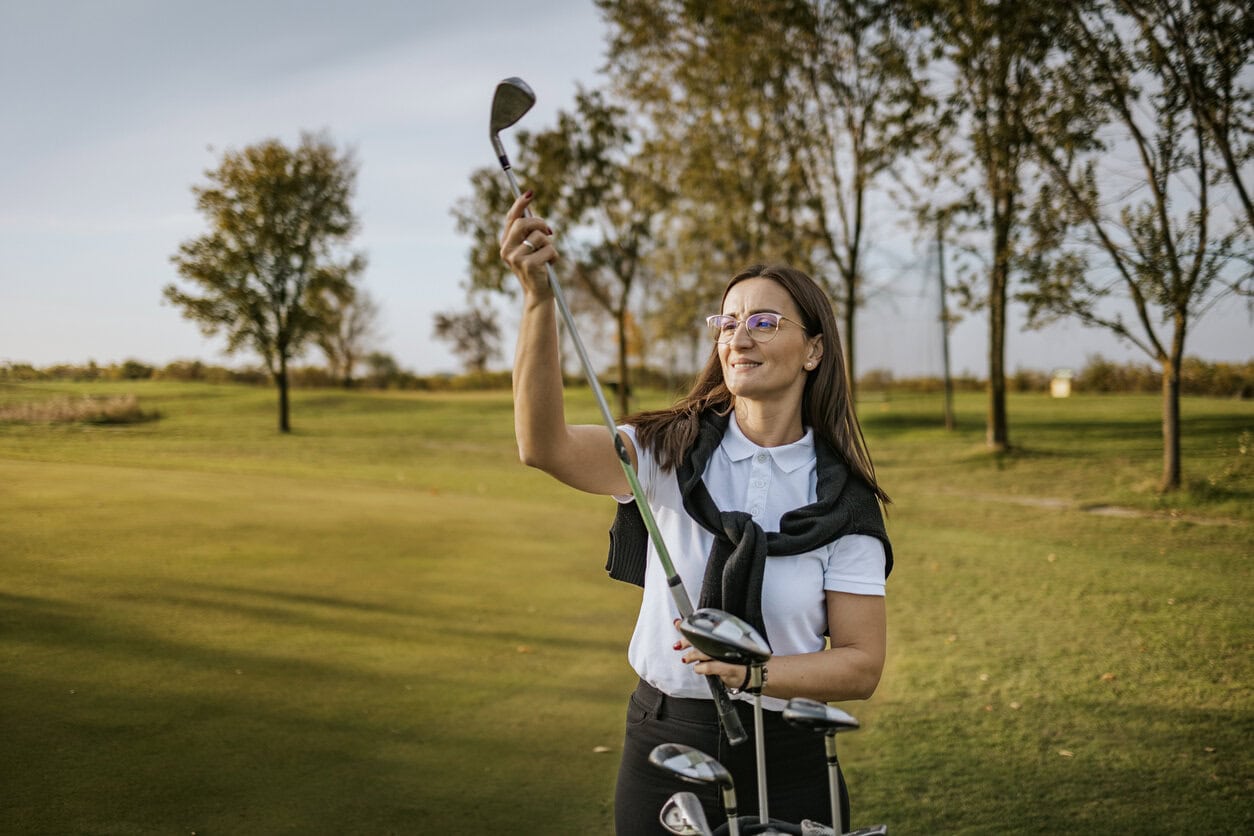
Varifocals can present a particular challenge because different parts of the lens are designed for different viewing distances.
Golf asks your eyes to do several different jobs. At address you’re looking down at a ball relatively close to you. Seconds later you’re trying to follow it potentially hundreds of yards into the distance. During the round you may also be reading a scorecard, checking a watch or GPS device and judging the contours of a green.
Some golfers are perfectly comfortable playing in their everyday varifocals. Others find the different viewing zones less convenient on the course.
There isn’t one prescription that will suit every golfer. Options an optometrist might discuss include single-vision distance glasses for golf, contact lenses or different multifocal solutions, depending on your eyesight and what you need to see.
The useful thing is to tell your optometrist how you use your eyes when you play golf. Explain if the problem is at address, following the ball, reading the green or moving between near and distance vision. That gives them much more useful information than simply saying you want a pair of glasses for golf.
Sunglasses: protection comes first
Bright sunlight brings another consideration.
The College of Optometrists advises choosing sunglasses carrying the appropriate UKCA or CE marking. A darker tint may reduce visible glare, but darkness alone does not determine the level of UV protection.
That distinction matters because prolonged UV exposure is associated with eye conditions including cataracts. A hat or visor can provide additional protection from direct sunlight.
If you normally wear prescription glasses, prescription sunglasses are an obvious option to discuss with your optometrist. Photochromic lenses, which react to changing light levels, may also be worth asking about if you regularly play in conditions that move between bright sunshine and cloud.
There are plenty of claims made about particular lens colours helping golfers see the ball or read greens. We found no sufficiently robust evidence to recommend one particular tint for improving golf performance.
Choose sunglasses primarily for appropriate protection, clear vision and comfort rather than expecting a particular lens colour to improve your game.

When the weather gets involved
Anyone who plays golf in Britain knows that glasses bring some very practical problems that have nothing to do with prescriptions.
Rain on the lenses can make following the ball difficult, while temperature changes can cause glasses to mist. Sunglasses can also become uncomfortable when conditions change repeatedly during a four-hour round.
Some golfers prefer contact lenses for those reasons, but whether contacts are appropriate depends on your eyes and prescription and is something to discuss with an optometrist.
Whatever you wear, the objective is straightforward: you need to be able to see comfortably throughout the round without your eyewear becoming another distraction.
When to get your eyes checked
Gradual changes are one thing. Some symptoms need more urgent attention.
The NHS advises seeking urgent help if you experience flashes or floaters for the first time, suddenly develop many more of them, or notice a dark curtain or shadow moving across your vision. Depending on the circumstances, that can mean requesting an urgent optician appointment or contacting NHS 111.
For less urgent changes, the golf course can simply be somewhere you first become aware that your eyesight isn’t quite what it was.
If you’re repeatedly struggling to follow the ball, finding your current glasses awkward at address or noticing that distance vision has changed, don’t start by buying something advertised specifically for golf.
Book an eye examination and tell the optometrist what you’re experiencing when you play.
You may simply need an updated prescription or a different solution for the course. Either way, it’s better to know what you’re trying to fix before you spend money trying to fix it.


