

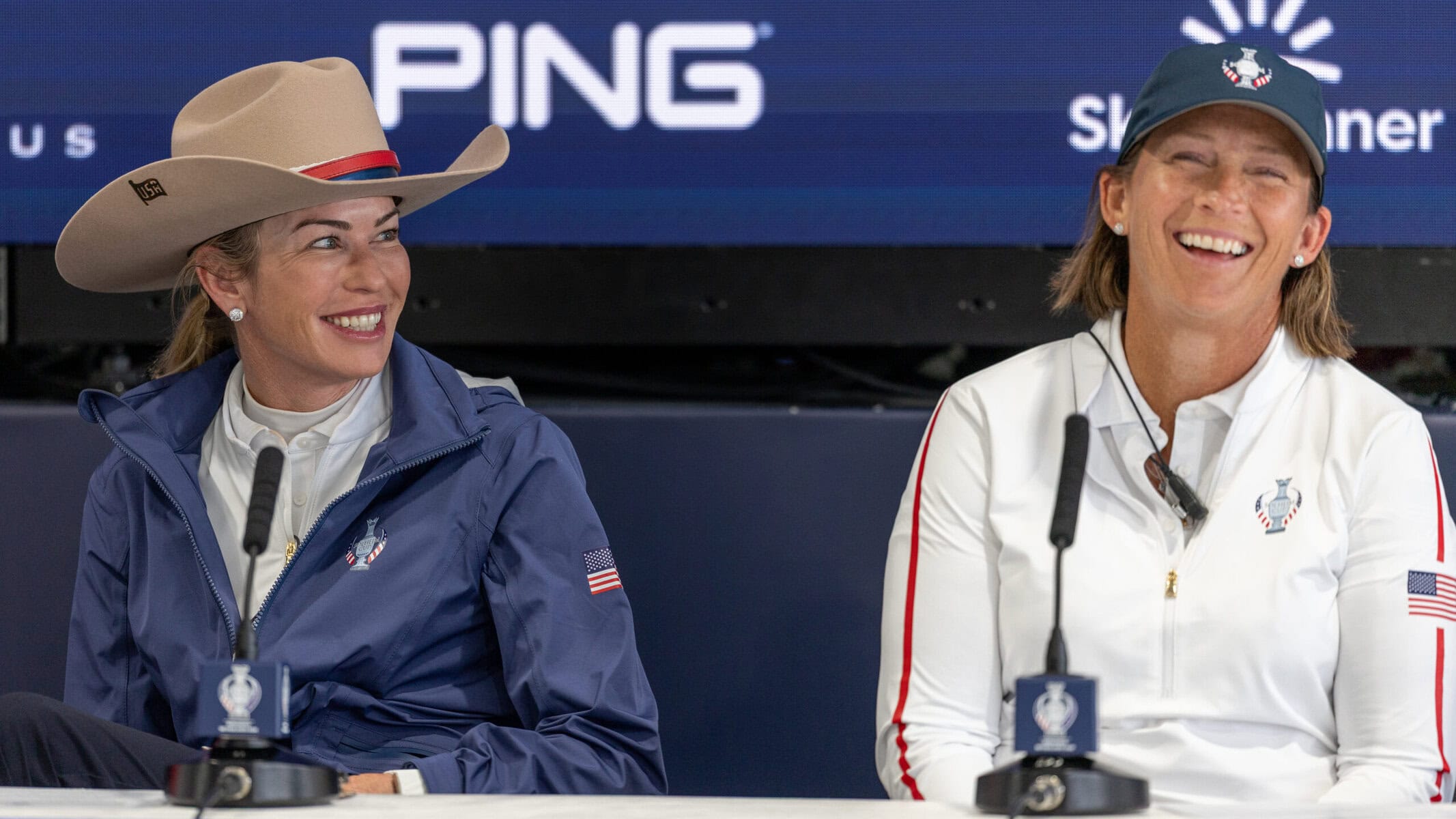
Angela Stanford has spent months studying the numbers behind her Solheim Cup team, but with Friday’s opening matches approaching, the US captain says instinct, course management and what she sees at Bernardus will now shape her final pairing decisions.
Angela Stanford has been working on her Solheim Cup combinations since March. She has tracked scores, studied who her players have been playing alongside, asked them who they would and would not like to partner and used data to help shape the practice groups now preparing at Bernardus.
But the Team USA captain believes there comes a point when the numbers have done their job.

Speaking alongside vice-captains Paula Creamer, Brittany Lang and Kristy McPherson on Tuesday, Stanford revealed that she sees the final stage of the selection process as roughly a 50-50 split between analysis and judgement.
“I think we’ve used the numbers to get us to this point and to get us into practice rounds,” she said. “And then this week is more about what you see with your eyes because there are more emotions, there’s a lot of other things going on.”
“This week is gut and eyeballs.”
Pairings have been taking shape since March

Photo Credit: Malcolm Mackenzie / LET
There is plenty for Stanford to work with.
Eight members of the American team that won the Solheim Cup in Virginia two years ago are back, while Nelly Korda and Allisen Corpuz have already established one of the competition’s strongest foursomes partnerships and Rose Zhang and Andrea Lee were hugely successful together in the 2024 fourballs.
Yet Stanford is not simply recreating old combinations.
She said practice groups are being mixed as the captaincy team assesses which players appear comfortable together at Bernardus. The work behind those decisions has been going on for six months, combining statistics with previous partnerships, personalities and direct feedback from the players themselves.
The course is part of the calculation too. Stanford expects Bernardus to play firm and fast and believes the height with which several of her players hit their approach shots could be an advantage on the greens.
One player who has particularly caught her eye in practice is rookie Auston Kim.
Stanford described watching Kim’s ball flight from close range as “pretty impressive”, adding that spectators may be surprised when they see her play in person. But the captain was equally pleased that her team did not yet appear to be at its competitive peak.
When asked when she wanted that to happen, the answer was simple: Friday morning.
Angel Yin will play

Photo Credit: Liu Zhuang / LET
There was also confirmation over the fitness of Angel Yin, whose preparation has been disrupted by illness.
Yin has completed two practice rounds at Bernardus and Stanford confirmed that she will play during the team sessions.
Under the captains’ agreement, every player will make at least one appearance before Sunday’s singles. Stanford said the US team would continue to monitor Yin, but stressed: “She’s here. She’s very happy to be here and she’s playing.”
How frequently Stanford uses Yin may therefore become one of the more interesting selection questions once play begins.
Can USA create their own energy in Europe?
The larger challenge is one Stanford has experienced before.
The USA arrive as defending champions but have not won the Solheim Cup on European soil since 2015. Vice-captain Brittany Lang was a member of that victorious team and believes the Americans have to accept the relative silence that accompanies good US golf away from home and generate their own momentum through birdies, chemistry and “American spirit”.
Stanford believes her players are equipped for it.

She repeatedly returned to their mental toughness, describing a group capable of letting setbacks go rather than allowing them to affect what happens next. In front of a predominantly European crowd, she believes that quality could become as important as anything revealed by the statistics.
“When you play in Europe, you have to be mentally tough, and you have to be together as a team,” she said.
With the quality of the two teams so closely matched, Stanford believes the decisive factor could ultimately be much less measurable.
“What do you have deep down that can get you over the finish line?”
That is something no spreadsheet can answer.
Keep up to date with all the news from the Solheim Cup – or Download our FREE App


