

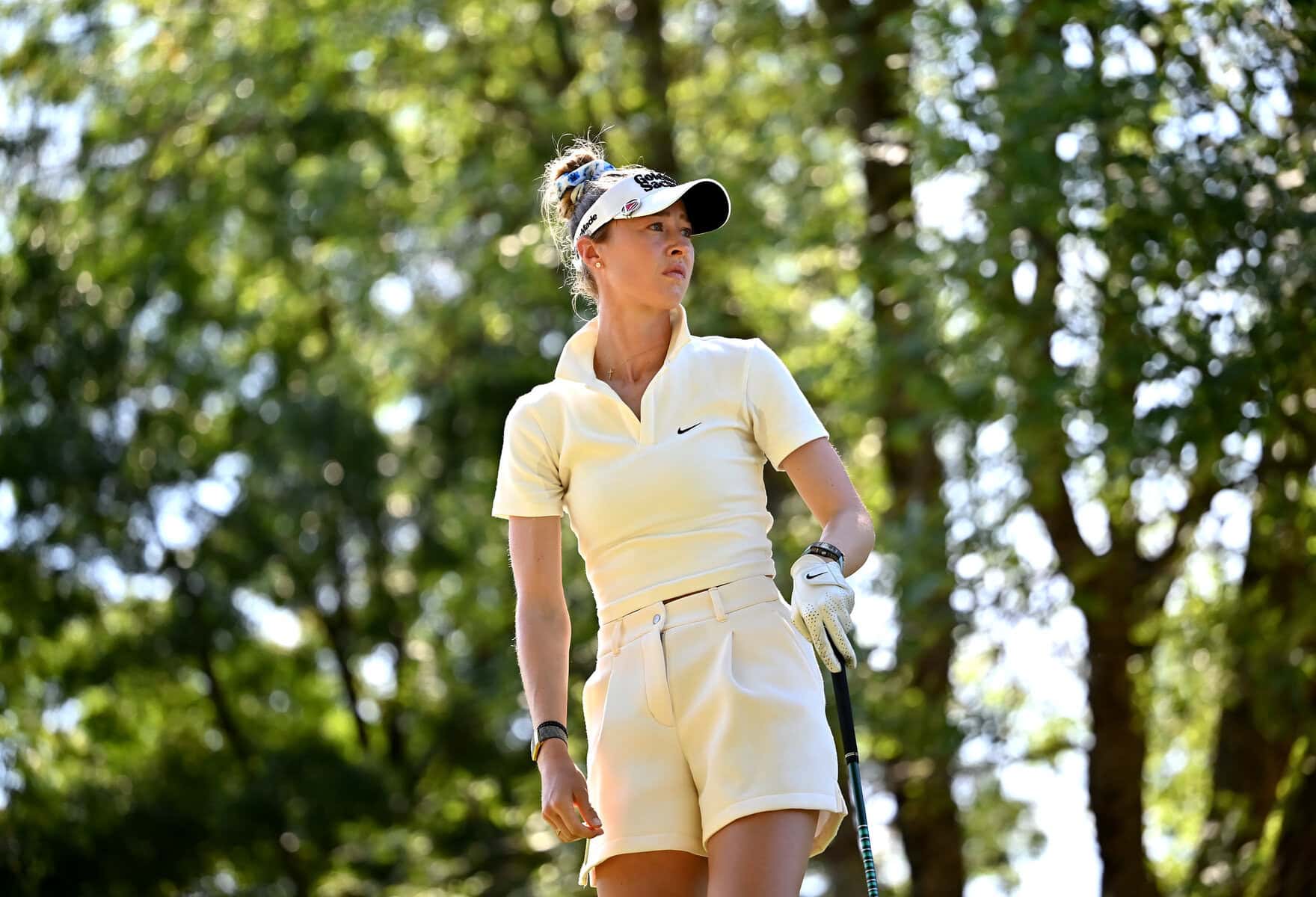
The defending champions arrive at Bernardus with Nelly Korda, eight members of the team that won in Virginia and some formidable Solheim Cup partnerships. Yet there is one achievement this generation of American players has yet to experience: winning on European soil.
There should be plenty of confidence in the American team room when Angela Stanford gathers her players at Bernardus this week.
Eight of the 12 were part of the side that reclaimed the Solheim Cup in Virginia two years ago. Only Auston Kim and Lindy Duncan are making their debuts and, unlike Europe, the USA arrive with several partnerships that have already proved themselves under Solheim Cup pressure.
On the surface, it looks like continuity could be America’s great strength. Stanford has inherited much of a winning team and resisted the temptation to change it dramatically.
But this is not Virginia.
The USA have not won a Solheim Cup in Europe since the extraordinary comeback at St Leon-Rot in Germany in 2015. Korda has never experienced an away victory. Nor have Megan Khang, Rose Zhang, Allisen Corpuz or most of the other established players in this side.
For all their recent Solheim Cup experience, winning in Europe remains unfinished business.

Plenty for Stanford to build on
The strongest argument for the USA is not simply the number of returning players, but what some of them have already achieved together.
Korda and Corpuz have played four foursomes matches as a partnership across the last two Solheim Cups and won all four. Zhang and Andrea Lee were equally impressive in Virginia, winning both of their fourball matches together, while Khang arrives unbeaten in her last eight Solheim Cup matches.
That gives Stanford something every captain wants before the week begins: combinations she already knows can work.
It matters particularly in foursomes, where pairing two outstanding individuals does not necessarily create an outstanding partnership. Players have to adjust to one another’s games and temperaments, and there is nowhere to hide when every shot belongs to both of them.
Stanford can choose to return to what worked in Virginia or use that experience to give herself more freedom elsewhere in the team. Either way, she is not beginning with a blank sheet of paper.
There is also the memory of winning together. The USA had gone three Solheim Cups without a victory before ending that sequence in 2024. Several members of this team know what it felt like to be part of the group that changed the momentum back in America’s favour.
The question is whether that confidence travels.
The Korda factor
No player will attract more attention in the American team than Korda.
The world number one has 23 career victories, more than the other 11 members of Stanford’s team combined, and remains the obvious figurehead of the side. Yet that statistic also illustrates why the American challenge cannot simply become the Nelly Korda show.
Korda was excellent for much of the 2024 Solheim Cup before running into an inspired Charley Hull in the Sunday singles, losing 6&4. The USA still won comfortably enough because the points were coming from elsewhere.
Zhang went 4-0. Lauren Coughlin was unbeaten. Khang won all three of her matches. The strength of that American victory was not that its biggest star carried the team, but that she did not have to.
Stanford will want the same at Bernardus.
There are some uncertainties. Angel Yin, the USA’s second automatic qualifier, has had a disrupted build-up after spending two months away from competition with stomach problems. Some familiar American names are also absent, including Lilia Vu and Lexi Thompson.
This is therefore an experienced Solheim Cup team, but not necessarily an American side overflowing with the highest-ranked players in the world.
That makes its established partnerships, match-play records and team chemistry all the more significant.
Why Europe is different
Stanford understands better than most what it takes to win away.
She was part of the 2015 American team that trailed Europe 10-6 heading into the singles in Germany and somehow came back to win. Stanford secured the point that completed the turnaround, and she has described that victory as her greatest Solheim Cup memory.
There is an obvious lesson in that experience. Away Solheim Cups can become emotional, uncomfortable and unpredictable very quickly. The crowd belongs to the other team and momentum can feel far more powerful when almost everyone around a green wants the same outcome.
Stanford appears to have considered that when constructing this side. She has spoken repeatedly about grit, heart and chemistry, and those qualities were part of the thinking behind selecting 35-year-old rookie Duncan. This is not a team chosen purely from a ranking sheet.

The irony is that Alison Lee is the only current American player who can share Stanford’s memories of winning in Europe in 2015. Eleven years later, she returns to the continent after another significant chapter in her career, having become a mother and then earned her place in the team through the world rankings.
For everybody else, an American victory at Bernardus would be a first.
Can the holders travel?
The USA deserve to arrive with confidence. They have the trophy, the world number one and a core of players who have already succeeded together in this competition. They also need only 14 points to retain the Cup, while Europe require 14½ to take it back.
But there is enough uncertainty to make the American challenge more interesting than the simple label of defending champions suggests.
Korda is the standout player, but Stanford will need points throughout the team. Yin’s preparation has been disrupted. Two rookies need integrating and the European crowd will be behind an opposition determined to respond to Virginia.
Most of all, this American generation has yet to prove it can win a Solheim Cup away from home.
Stanford has.
That may prove one of the most valuable pieces of experience in the US team room this week. She knows how quickly a European Solheim Cup can turn, but she also knows that the noise and home advantage can be overcome.
The USA already know they can win together. At Bernardus, we discover whether they can do it on away soil.
Keep up to date with all the news from the Solheim Cup


