


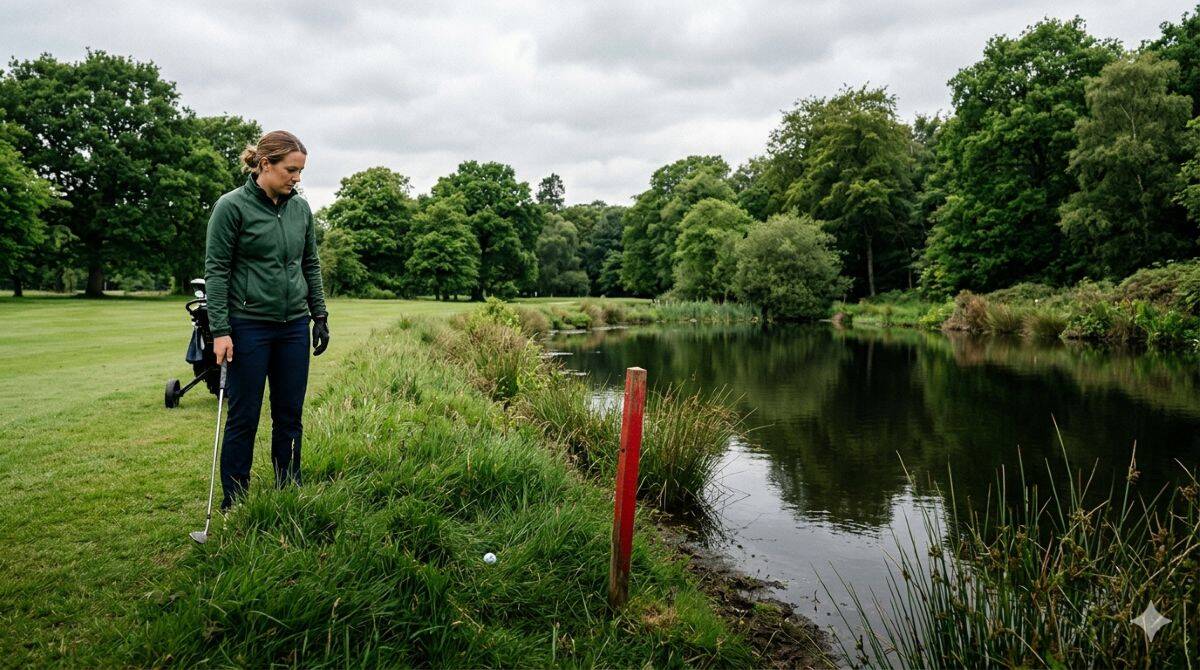
Those red stakes aren’t just markers. They give you options — if you know what they are.
You’ve hit into a penalty area. It’s going to cost you a shot. But do you know which relief options you actually have? The answer depends on whether the posts are red or yellow — and plenty of club golfers don’t know the difference.
Here’s the key thing about red penalty areas: you have three ways out. Yellow gives you two. That extra option — lateral relief — is often the most practical, and it’s exclusive to red.
Watch the video below for a clear visual walk-through, then read on for the full breakdown.

First — what exactly is a penalty area?
Since 2019, what used to be called water hazards are now called penalty areas. They don’t have to contain water — they’re simply areas defined by the committee where a ball is often lost or unplayable. Some are marked red, some yellow.
The edge of a penalty area is defined either by where the stakes line up with each other, or by a chalk or paint line (which you’ll typically see marked before a competition).
Option one: Play it as it lies
If your ball is findable and you can take a swing, you’re allowed to play it from the penalty area with no penalty at all. Since 2019, you can also ground your club and take a practice swing in there — the old rule requiring you to hover the club is gone.
Option two: Back on the line
This one catches people out because it’s often confused with line of flight — the direction the ball came in from. It’s not the same thing.
Back on the line relief means you identify the exact point where your ball last crossed the edge of the penalty area, keep that point between you and the hole, and drop anywhere on that line going back away from the hole. There’s no limit to how far back you can go.
When you drop, the spot where the ball first touches the ground becomes your reference point. Your relief area is one club-length in any direction from that spot — forming a small half-circle. The ball must come to rest in that area. One penalty stroke.
Option three: Stroke and distance
Always available, whatever colour the posts. Go back to where you played your last shot from and play again from there, dropping at knee height. If your last shot was a tee shot, you can re-tee anywhere in the teeing area.
Option four (red only): Lateral relief
This is the one yellow penalty areas don’t give you, and it’s often the most useful option in practice.
Drop within two club-lengths of the point where your ball last crossed the edge of the penalty area — no nearer the hole. That reference point is the exact spot on the edge where the ball came in, so it’s worth taking a moment to identify it before you do anything else. From there, two club-lengths forms a relief area roughly shaped like a pie slice. Drop at knee height within that area, and you’re playing. One penalty stroke.
One thing worth knowing
You don’t need to find your ball to take relief. If it’s known or virtually certain it ended up in the penalty area — even if you can’t see it — you can take relief as though you found it there.
The short version
Red penalty area: play it, go back on the line, go back to your last shot, or drop laterally within two club-lengths. All relief options cost one penalty stroke.
Yellow penalty area: the same, minus the lateral option.
Marcela Smith, USGA Certified Rules Expert and founder of Girlfriends Guide to Golf. Marcela teaches golf rules and etiquette through her unique Girlfriends Golf Experience — on-course clinics that help women (and all golfers) build confidence, avoid penalties and lower their scores. girlfriendsguidetogolf.com | @girlfriendsguidetogolf


