

A no-nonsense guide to choosing the right driver — whether you’re an Established Golfer looking for more forgiveness, an Improver chasing extra yards, or an Advanced Golfer fine-tuning performance.
This guide is here to help you understand what actually matters when choosing a driver — and what you can safely ignore. We won’t rank products, pick favourites, or push you towards any particular brand. Instead, we’ll walk you through the decisions that make the difference between a driver that works for your game and one that sits in the bag collecting dust.
There’s a lot of noise around drivers. More than any other club in the bag, they attract the biggest marketing budgets and the boldest performance claims. This guide cuts through that. It’s built to help you ask better questions, understand what the specs actually mean, and walk into a fitting or a shop knowing what matters for your swing.
Brand new to golf? Head to our First Swings section for advice on getting started.
The Decisions That Matter
Loft: More Than You Think
Loft is the angle of the clubface, and it has a bigger effect on your driving than almost anything else. Too little loft and you won’t get the ball airborne consistently. Too much and you’ll sacrifice distance. Most women golfers benefit from more loft than they think — typically between 12 and 15 degrees, though the right number depends entirely on your swing speed and angle of attack.
The temptation is to copy what you see on tour or what a playing partner uses. Resist it. A driver with the right loft for your swing will fly further and straighter than one with a lower number on the sole that you’re muscling into the air. A fitting session with a launch monitor will show you exactly where the sweet spot is.
Shaft: Weight, Flex, and Length
The shaft is the engine of the driver, and it’s where many off-the-rack clubs let women golfers down. Three things matter most: weight, flex, and length. A shaft that’s too heavy will slow your swing. One that’s too stiff won’t load properly and you’ll lose both distance and feel. Standard women’s shafts tend to be lighter and more flexible, but “standard” doesn’t mean right for you.
Length matters too. A longer shaft can generate more clubhead speed in theory, but only if you can control it. Many golfers — including some with faster swings — hit it better with a driver that’s half an inch or even an inch shorter than standard. Again, this is something a fitter can test and measure.
Head Size and Forgiveness
Most modern drivers have a 460cc head — that’s the maximum size allowed under the rules. A larger head generally means a larger sweet spot and more forgiveness on off-centre hits, which is measured by something called MOI (moment of inertia — essentially how resistant the head is to twisting when you don’t hit the middle). Higher MOI means straighter mis-hits.
For most golfers, maximum forgiveness is a good thing. Some advanced players prefer a slightly smaller or more compact-looking head because it gives them a better sense of control and workability — the ability to shape shots left or right. But unless you’re actively shaping drives, forgiveness should be the priority.

Adjustability: Do You Need It?
Many drivers now come with adjustable hosels (the piece that connects the head to the shaft), moveable weights, or both. These let you fine-tune loft, lie angle, and shot shape after purchase. Adjustability is genuinely useful — if you know what you’re adjusting and why. A fitter can set these for you during a session, and you can tweak them later as your game develops.
That said, adjustability adds cost. If you’re on a tighter budget, a well-fitted non-adjustable driver will outperform a badly fitted adjustable one every time. Don’t pay for features you won’t use.
What Matters at Your Level
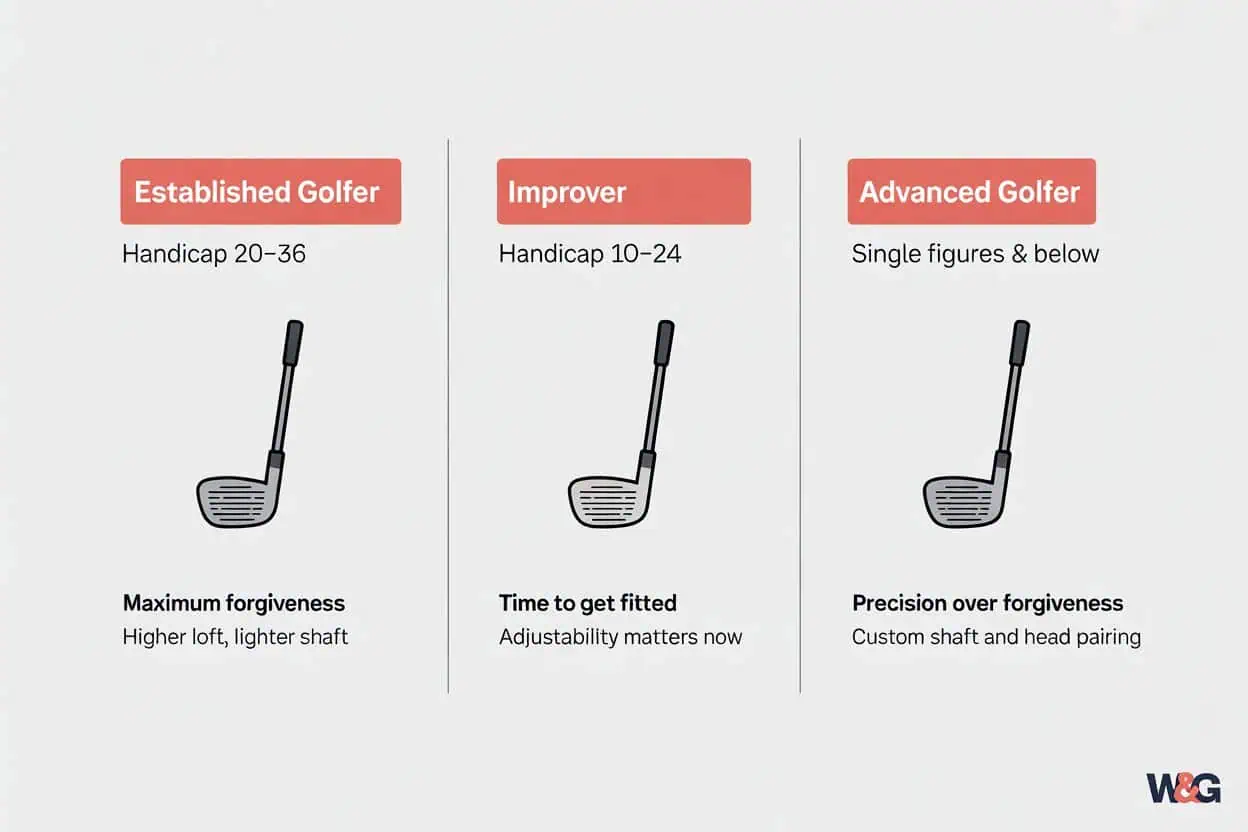
The Established Golfer (handicap 20–36) — Your priority is getting the ball in the air consistently and keeping it in play. Look for maximum forgiveness, a higher loft (13–15 degrees is a good starting range), and a lightweight shaft that lets you swing freely. Don’t get drawn into features designed for faster swings. A driver that helps you find the fairway more often will do more for your enjoyment — and your scores — than one that promises an extra ten yards you’ll never see.
The Improver (handicap 10–24) — You’re generating more speed now and your strike is becoming more consistent. This is a great time to get fitted properly, because you’re changing fast. You might find you need a slightly stiffer shaft or a touch less loft than when you started. Adjustability becomes more useful here, because you can adapt the club as your swing develops rather than replacing it.
The Advanced Golfer (single figures and below) — You know what your miss is and you want a driver that helps you manage it. You might be looking at shafts and heads separately rather than buying off the rack. Some advanced players prefer a men’s head with a lighter or women’s-flex shaft — a good fitter will explore every option. At this level, small differences in spin, launch angle, and dispersion matter, and only a launch monitor session will give you the data to make the right call.
Budget
Drivers sit across a wide price range. The most expensive models tend to offer the latest materials, more adjustability, and incremental performance gains. But last season’s model at a reduced price will be almost identical in performance for most golfers. The technology in drivers has been excellent for several years now, so buying one generation back is a smart move.
Factor in the cost of a fitting. Some retailers include it in the purchase price; others charge separately but offset it against a purchase. A fitted driver at a mid-range price will almost always outperform a top-of-the-range driver bought off the shelf. Spend your money on fit first, features second.
The Jargon Buster
- Loft: The angle of the clubface relative to the shaft. Higher loft launches the ball higher.
- MOI (Moment of Inertia): A measure of how resistant the clubhead is to twisting on off-centre strikes. Higher MOI means more forgiveness.
- Flex: How much the shaft bends during the swing. Common ratings run from Ladies (L) through Regular (R) to Stiff (S), but these aren’t standardised across brands.
- Launch angle: The angle the ball leaves the clubface. Affected by loft, swing speed, and angle of attack.
- Spin rate: How fast the ball spins after impact. Too much spin costs distance; too little and the ball won’t stay in the air.
- Adjustable hosel: A mechanism that lets you change the loft or lie angle of the driver head after purchase.
- Centre of gravity (CG): The balance point inside the clubhead. Where it sits affects launch, spin, and forgiveness.
- Dispersion: The spread of your shots across a series of drives. Tighter dispersion means more consistency.
Before You Buy
Get fitted. We say it in every guide because it’s the single best thing you can do when buying a driver. A professional fitting takes your swing speed, launch conditions, and tendencies into account and matches you to the right combination of head, shaft, loft, and length. Most high street golf retailers and many club professionals offer fitting sessions, and the data you’ll see on a launch monitor is genuinely eye-opening.
If you’re buying online or second-hand, try to hit the club first. Drivers feel very different from one to the next, and numbers on a spec sheet won’t tell you whether a particular club inspires confidence at address. That feeling matters more than most golfers realise.
Finally, don’t rush. A driver is one of the most expensive clubs in the bag and one you’ll use on most holes. Take your time, hit plenty of options, and trust the data over the marketing.
About This Guide
This is a Women & Golf buying guide. We do not rank products, accept payment for inclusion, or favour any brand. For detailed reviews of individual drivers, see our Drivers and Woods section.
First published: March 2026