


You’ve taken the plunge, had a few golf lessons and discovered that you rather enjoy it. But what happens when the lessons finish and you’re not quite sure what to do next? Here’s how to keep playing, build confidence and make golf part of your life.
There’s something rather lovely about those first few golf lessons. You’re learning something new, meeting people and beginning to understand why so many people become hooked on the game.
Then the course finishes.
You might have learnt how to hold a club, hit a reasonable shot and perhaps even managed a few holes. But you’re not quite ready to describe yourself as a golfer. You don’t belong to a club, you haven’t got anyone to play with and you’re certainly not ready for a competition.
So what now?
This is a point at which many women find themselves unsure how to continue. As we explored in our recent Building Her Game feature, the transition from beginner lessons to regular golf isn’t always straightforward.
But here’s the good news. You don’t need to join a golf club, buy a complete set of clubs or be particularly good at golf to keep enjoying it.
You simply need to find your next step.
Don’t let your lessons be the end of the story
If you’re still having lessons, now is the time to ask your coach what comes next.
Does the club run follow-on sessions? Are there beginner playing groups? Could you arrange another lesson with some of the women you’ve met?
Many golf clubs and teaching professionals offer programmes designed to help beginners move from the practice ground onto the course. They might involve a few holes with a coach, informal group sessions or opportunities to play with more experienced golfers.
If nothing is organised, don’t be afraid to ask. You may find that several women in your group are wondering exactly the same thing.
The important thing is to have something in the diary. Golf is much easier to continue when you have a reason to pick up your clubs again.
You don’t have to play 18 holes

One of the biggest misconceptions about golf is that playing means spending four hours or more on an 18-hole course.
It doesn’t.
Nine holes can be a wonderful way to start. So can a short course, a par-three course or even a few holes on a quiet afternoon.
In fact, shorter formats can be particularly enjoyable when you’re learning. There’s less pressure, you have more opportunities to practise different shots and you can concentrate on enjoying yourself rather than worrying about completing a full round.
If the idea of heading onto a course still feels daunting, ask whether your local club has quieter times when beginners are welcome.
And remember, there’s nothing wrong with continuing to visit the driving range while you build up the confidence to play.
Golf doesn’t have to take up your whole day to become part of your life.

Find someone to play with
For many new golfers, finding playing partners is a bigger challenge than hitting the ball.
During lessons, everything is organised. You arrive at a particular time, meet the same people and have a professional guiding you.
Once the lessons finish, that structure disappears.
The simplest solution might be sitting right beside you at your final session.
Before everyone heads home, suggest exchanging numbers or setting up a small WhatsApp group. You could arrange to meet at the driving range, book a short course or simply have a coffee and discuss what you’d all like to do next.
You don’t need a large group. Finding just one other person who is happy to learn alongside you can make an enormous difference.
If nobody from your lessons is available, ask local clubs about beginner groups, women’s social golf sessions or informal roll-ups.
There are also online communities where women can connect with other golfers.
The aim isn’t necessarily to find someone who plays at your level. It’s to find people who make you feel comfortable while you’re learning.
Keep having lessons, but start playing too
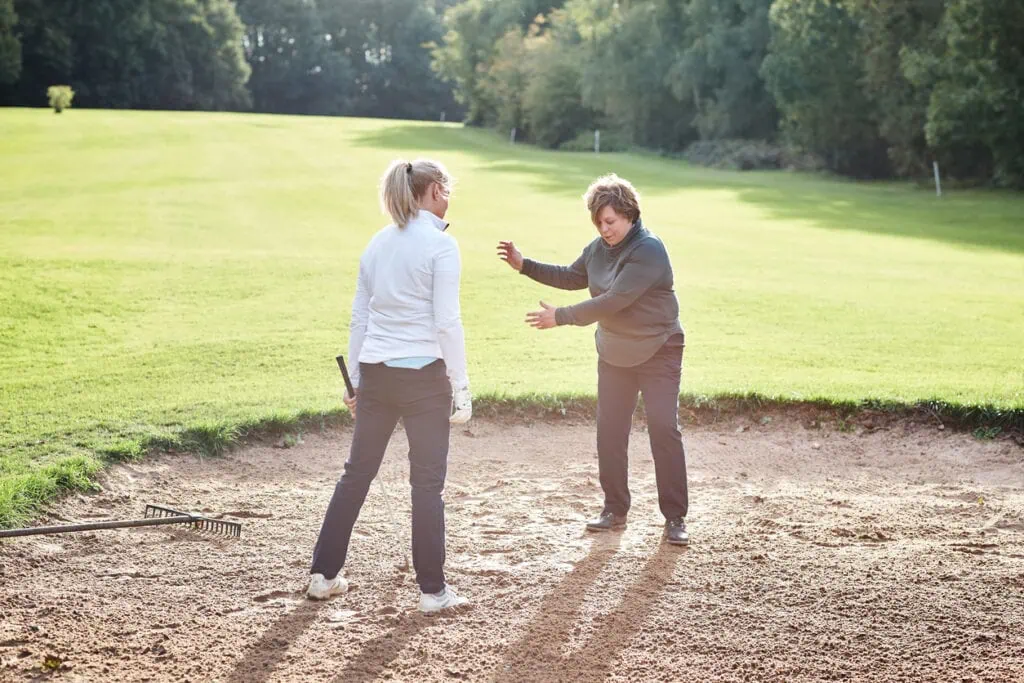
It’s tempting to think that you need to get better before you’re ready to play on a course.
Perhaps you’re still struggling with your driver. Maybe your putting is inconsistent or you occasionally miss the ball altogether.
Welcome to golf.
Even experienced golfers have days when very little goes according to plan.
Lessons are valuable, and continuing to work with a coach can help you develop your skills. But practising on a driving range and playing golf are two different experiences.
On a course, you’ll encounter uneven lies, bunkers, trees, slopes and all sorts of situations that don’t appear during a lesson.
You’ll also begin to understand how the game works: where to aim, which club to choose, when to pick up your ball and how to keep things moving.
You don’t have to master all of this immediately.
A good approach is to combine occasional lessons with opportunities to play. You’ll soon discover which parts of your game need attention, and your next lesson will be all the more useful.
Don’t rush into buying everything
Golf equipment can be expensive, and it’s easy to feel that you need to invest in a complete set of clubs, golf shoes, clothing and accessories before you can take the game seriously.
You don’t.
If you’ve been borrowing clubs during lessons, ask your coach what they recommend for your next stage.
A small selection of suitable clubs may be perfectly adequate while you’re learning. Some facilities also have clubs available to hire or borrow.
If you’re thinking about buying your own, consider second-hand or beginner sets rather than assuming you need the latest equipment.
The same applies to golf club membership.
You may eventually decide that joining a club is exactly what you want. Membership can provide regular playing opportunities, competitions, friendships and a sense of belonging.
But there’s no need to make that decision immediately.
Explore the options available locally. Some clubs offer flexible membership, introductory packages or pay-and-play opportunities. Public courses and driving ranges may also suit you perfectly.
Find out how you enjoy playing golf before committing to how much you want to spend on it.
Give yourself permission to be a beginner
Perhaps the most important thing to remember is that you are allowed to be new at something.
You are allowed to hit a bad shot.
You are allowed to lose a ball, take several attempts to escape a bunker or decide that you’ve had enough after six holes.
You are even allowed to pick up your ball and move on when a hole isn’t going particularly well.
Golf has rules and etiquette, of course, and it’s worth learning the basics, particularly how to play safely and keep up with the group ahead. But you don’t need to know everything before you start.
If you’re playing socially with other beginners, agree beforehand that you’re there to learn and enjoy yourselves.
Celebrate the good shots. Laugh about the terrible ones. And don’t judge your progress entirely by your score.
One week you might hit a lovely drive. Another week you might simply feel more relaxed walking onto the first tee.
Both are progress.

Make golf something you look forward to
When you’re beginning, consistency is more important than intensity.
You don’t have to practise every day or play every weekend.
Perhaps you can manage nine holes twice a month. Perhaps Wednesday evening becomes your regular driving-range session with a friend. Or perhaps you arrange a group lesson once a fortnight.
The best approach is the one that fits comfortably into your life.
And remember that golf is about more than the shots you hit.
It’s time outdoors, an opportunity to meet people, a chance to learn something new and, quite often, a very enjoyable excuse for coffee and conversation afterwards.
If you’ve enjoyed your first lessons, you’ve already discovered something worth continuing.
Don’t let the uncertainty of what happens next stop you.
Your next three steps
Before you put your clubs away, make three small commitments to yourself:
- Put another golf date in your diary. A lesson, a driving-range visit or a few holes — anything that keeps you playing.
- Find someone to share the experience. Contact a woman from your lessons or investigate local beginner-friendly groups.
- Choose somewhere you’d feel comfortable playing. It doesn’t have to be a championship course. Start somewhere that makes you want to return.
And one final thought. You might not feel like a golfer yet. You might still describe yourself as someone who’s just learning.
But if you’re picking up a club, enjoying the challenge and looking forward to doing it again, you’re already a golfer.
Welcome to the game.
READ MORE: First Swings Articles


