


Most golfers never choose a ball at all. They just play whatever’s in the bag. This guide is for the Established Golfer, the Improver and the Advanced Golfer who want to understand what actually matters before they buy their next dozen.
Golf ball choice tends to get boiled down to one question: what’s your swing speed? It’s a reasonable place to start, but it’s not the whole story, and treating it as the whole story is how a lot of golfers end up with a ball that doesn’t suit them. This guide walks through the real decisions- durability, spin, feel, construction and budget- and how they apply differently depending on where you are in your game. It won’t rank balls or tell you which one to buy.
The Decisions That Matter
- Durability and cost vs. performance
Before spin rates and compression numbers, there’s a more basic question: how many balls do you actually lose in a round? Club golfers lose more than one ball, on average, every time they play. If that’s you, a premium tour-style ball is an expensive habit rather than an upgrade. You’re paying a premium for performance characteristics you won’t get the chance to feel before the ball is in a lake. A durable, mid-priced ball you can afford to lose without wincing is often the more useful choice, and there’s no shame in that.
- Swing speed and compression
Compression is a measure of how much a ball deforms when the clubface hits it. Softer balls compress more easily, firmer balls need more force behind them. The traditional advice is that slower swing speeds should play lower-compression balls and faster swings should play firmer ones, and as a rough starting point that still holds.
But it’s worth knowing the picture is more nuanced than the old rule suggests: independent robot testing has shown that even fairly modest swing speeds are enough to compress the core of most balls, and the real risk sits at the other end. A fast swing over-compressing a very soft ball, rather than a slow swing failing to compress a firm one. In practice, compression is a useful guide, not a strict rule.
- Spin and control

Spin is what makes a ball climb, hold its line and stop on the green and it’s created mainly by pairing a soft outer layer with a firmer layer underneath, so the cover grips the clubface for a fraction longer at impact.
More spin isn’t automatically better. Extra spin off the tee can mean less distance and more curve on a mis-hit, which is exactly what a developing player usually doesn’t want. Around the greens, though, a bit more spin is often exactly what helps a ball check up rather than release across the putting surface. The real question isn’t “how much spin” but “where do I actually need it” -off the driver, or inside 100 yards.
- Feel and sound off the face
This is the one area where there’s genuinely no right answer as ‘feel’ is personal. Some golfers want a soft, quiet strike; others prefer something firmer that gives clear feedback on contact. Feel is shaped by the cover material as much as compression, so two balls with similar compression numbers can feel completely different in the hand and off the face. If you’ve got two balls that perform similarly on paper, let feel be the tiebreaker
- Construction: what the layers actually do
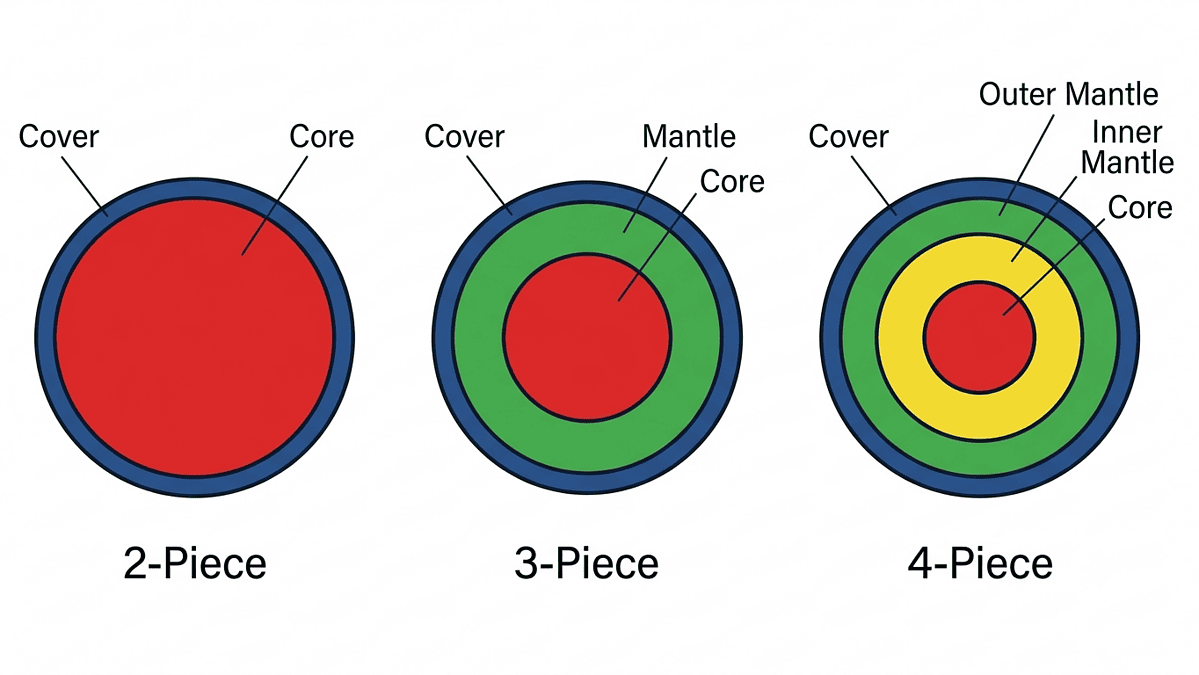
Golf balls are described by their number of “pieces”, meaning layers. A two-piece ball is a core and a cover- the simple, durable and usually the cheapest option, built for distance and straightness rather than spin. Add a middle layer (a mantle) and you get a three-piece ball, which typically adds more greenside spin and a softer feel without giving up much distance.
Four- and five-piece balls add further layers designed to separate how the ball behaves off the driver from how it behaves on wedge shots, generally aimed at faster, more consistent swings that can take advantage of the extra engineering. More layers is not automatically better. It’s a trade-off between control and cost, and a well-made two-piece ball will still out-perform a poorly suited premium one.
What Matters at Your Level
The Established Golfer (handicap 20–36): durability and value matter more here than chasing extra spin. A two-piece or soft three-piece ball that launches easily and survives a few mis-hits will serve you better than a tour ball designed for shots you’re not yet hitting consistently. Save the money for lessons or a fitting instead.
The Improver (handicap 10–24): this is where ball choice starts to earn its keep. As contact becomes more consistent, you’ll start to notice differences in short-game feel and how the ball reacts on and around the green. A mid-tier three-piece ball is a sensible place to start experimenting — try a sleeve at a time rather than committing to a dozen.
The Advanced Golfer (single figures and below): compression, spin and construction genuinely affect your scoring now, particularly inside 100 yards. It’s worth being precise here. The difference between balls in this category shows up far more in wedge control than in driver distance, so test with your scoring clubs, not just off the tee.
Budget
Ball prices vary hugely, and the most expensive box on the shelf isn’t automatically the right one for you. As a rough guide, expect to pay more for balls with additional layers and urethane covers, and less for durable two-piece distance balls. If you’re losing several balls a round, that cost adds up fast so factor in how much golf you actually play when deciding where to spend.
The Jargon Buster
Compression: a measure of how much a ball deforms on impact. Lower numbers mean a softer ball that compresses more easily; higher numbers mean a firmer ball.
Spin: how much the ball rotates in flight and on landing. More spin generally means more control and stopping power on the green, but can mean less distance and more curve off the tee.
Construction (or “pieces”): the number of layers inside the ball. More layers generally means more separation between how the ball performs off the driver and how it performs on short shots.
Cover material: the outer skin of the ball, usually either a tougher ionomer (sometimes called Surlyn) or a softer urethane. Ionomer covers are more durable and spin less; urethane covers are softer and spin more, especially around the greens.
Launch angle: the angle the ball leaves the clubface at. It affects how high the ball flies and how it lands, and is influenced by both the ball and your swing.
Dimple pattern: the arrangement of dimples on the cover, which affects aerodynamics i.e. how the ball holds its line and carries through the air.
Before You Buy

A proper fitting is still the best way to find the right ball, and it doesn’t have to mean a full session with a launch monitor. Most major ball manufacturers offer free online fitting quizzes that ask about your swing, your typical miss and what you want from your short game, then point you toward a sensible starting range. Treat the result as a shortlist, not a final answer.
The good news is that testing a golf ball is far cheaper than testing a driver. Buy a sleeve of three rather than a full dozen, play a few rounds, and pay attention to how it behaves on shots inside 100 yards as that’s where most golfers actually notice a difference. If you play in a wide range of conditions, it’s also worth knowing that colder weather makes any ball feel and perform firmer, which can be worth factoring in if you play through the winter.
Once you’ve found a ball that suits you, sticking with it for a season is worth doing. Getting used to how a specific ball behaves around the greens will do more for your short game than switching between balls every few rounds looking for a marginal gain.
About This Guide
This is a Women & Golf buying guide. We don’t rank products, and no manufacturer has paid for inclusion or placement. For reviews of specific golf balls, see our related product reviews and articles.
First published: July 2026


