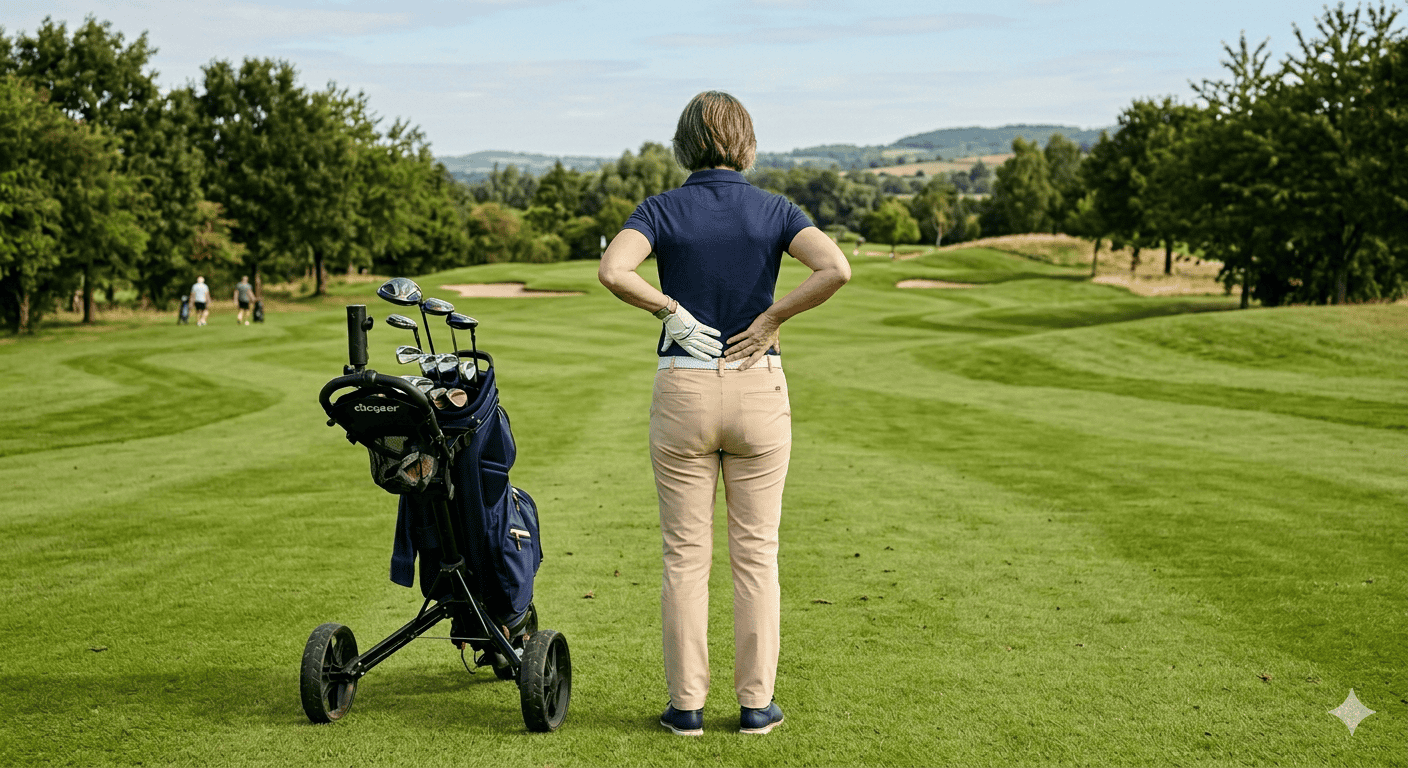
Your lower back takes a lot of blame on the golf course — but according to the experts at the Titleist Performance Institute (TPI), it’s often not the real culprit. Watch their coaches break it down in the video below, and read on for the key tests and fixes.
Back pain is one of the most common complaints in golf. TPI estimates that over 70% of golfers have played through it at some point. The problem is that most of us treat the symptom — the aching lumbar, the twinge at the top of the backswing — without addressing what’s driving it. And in many cases, the real issue is somewhere else entirely.
Your hips may be doing less than they should
The lower back sits between two major moving parts: the thoracic spine above and the hips below. When the hips lose range of motion, the lower back picks up the slack. In a golf swing, that’s a serious problem.
TPI coaches use a simple internal rotation test to check whether the hips are a factor — you can see it demonstrated in the video below. Try it yourself: sit on the floor with your fists between your knees, then let your feet fall outward as far as they comfortably go. If one foot barely moves while the other travels freely, you’ve likely found a backswing limitation — and a probable source of back stress.
Here’s why: your lower back is designed for very little rotation — roughly one or two degrees per segment, perhaps ten degrees in total. Your golf swing asks for far more than that. If your hips aren’t delivering their share of the rotation, the lower back fills in. It’s trying to help, but that’s exactly how it gets hurt.
Balance: the test most golfers overlook
The second factor TPI flags is balance — specifically, single-leg balance with eyes closed. Stand on one leg, bring your knee up, and once you’re steady, close your eyes. TPI’s benchmark for LPGA and PGA players is 15–20 seconds.
The general human norm is around 10 seconds. If you’re wobbling or stepping down well before ten, there’s work to do. Watch the TPI coaches demonstrate the test — and see just how demanding it looks when done properly — in the video below.
Why does this matter for your back? When your balance is solid, your core and glutes are doing their job — holding your centre stable so your limbs can move freely. Without that stability, rotational and lateral forces in the swing pass through the lower back rather than being absorbed through the whole system. As TPI puts it, balance is the glue that holds every other fitness quality together.
Two exercises to watch — then try
Both exercises below are demonstrated in full in the TPI video. Watch the technique first, then give them a go at home.
Hip drops (windshield wipers)
Sit on the floor with your hands behind you for support. Let your knees fall to one side, then the other, keeping both sit bones on the ground. Don’t force the range — only go as far as your body allows without one hip lifting. As the TPI coaches point out in the video, this looks easy but it isn’t — and going slowly is the whole point. Try 10–15 repetitions each side.
Single-leg balance with overhead reach
Stand on one leg with your knee raised to 90 degrees. Hold a ball or light weight and pass it overhead, then back in front of you, while maintaining your height throughout. Think of your foot as a tripod — three points of contact with the ground, all equally weighted. This trains the whole chain from ankle to spine to stay active and stable, which translates directly to a more supported golf swing.
Both take less than five minutes combined and need nothing more than a ball.
If your back flares up regularly, these two tests are a useful starting point for understanding why. Limited hip rotation and poor single-leg balance are both correctable — and addressing them takes the pressure off the part of your back that was never designed to handle it.
If you have an existing back condition or have had a recent injury, check with your GP or physiotherapist before starting any new exercise programme.
Explore more from our friends at TPI at https://www.mytpi.com/ and learn more about the Lance Gill Performance team here: https://lgperformance.com/
Watch: TPI coaches demonstrate the hip rotation test, the single-leg balance test, and both exercises — with full technique guidance.